
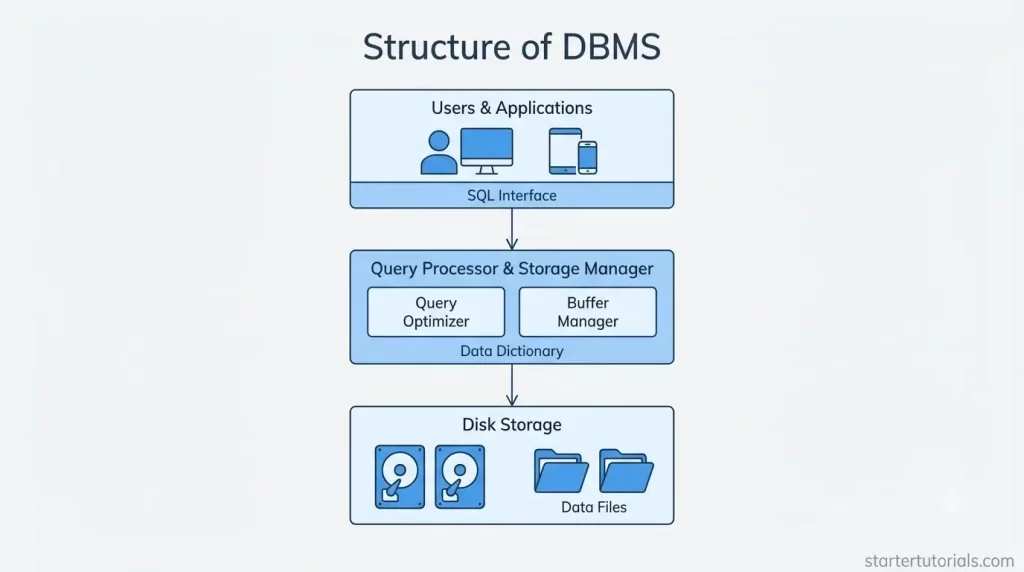
Understanding the structure of a DBMS is essential to learning how modern databases handle complex queries in milliseconds while keeping data secure and reliable. By breaking down the DBMS structure, you can see how each component coordinates memory, optimizes query execution, handles concurrent user transactions, and guarantees data durability against system crashes.
What is structure of DBMS?
The structure of a Database Management System (DBMS) represents its internal software architecture, a layered system designed to execute high-level user requests efficiently while managing data storage safely on physical hardware.
The structure of a DBMS can be represented as shown in the following diagram:
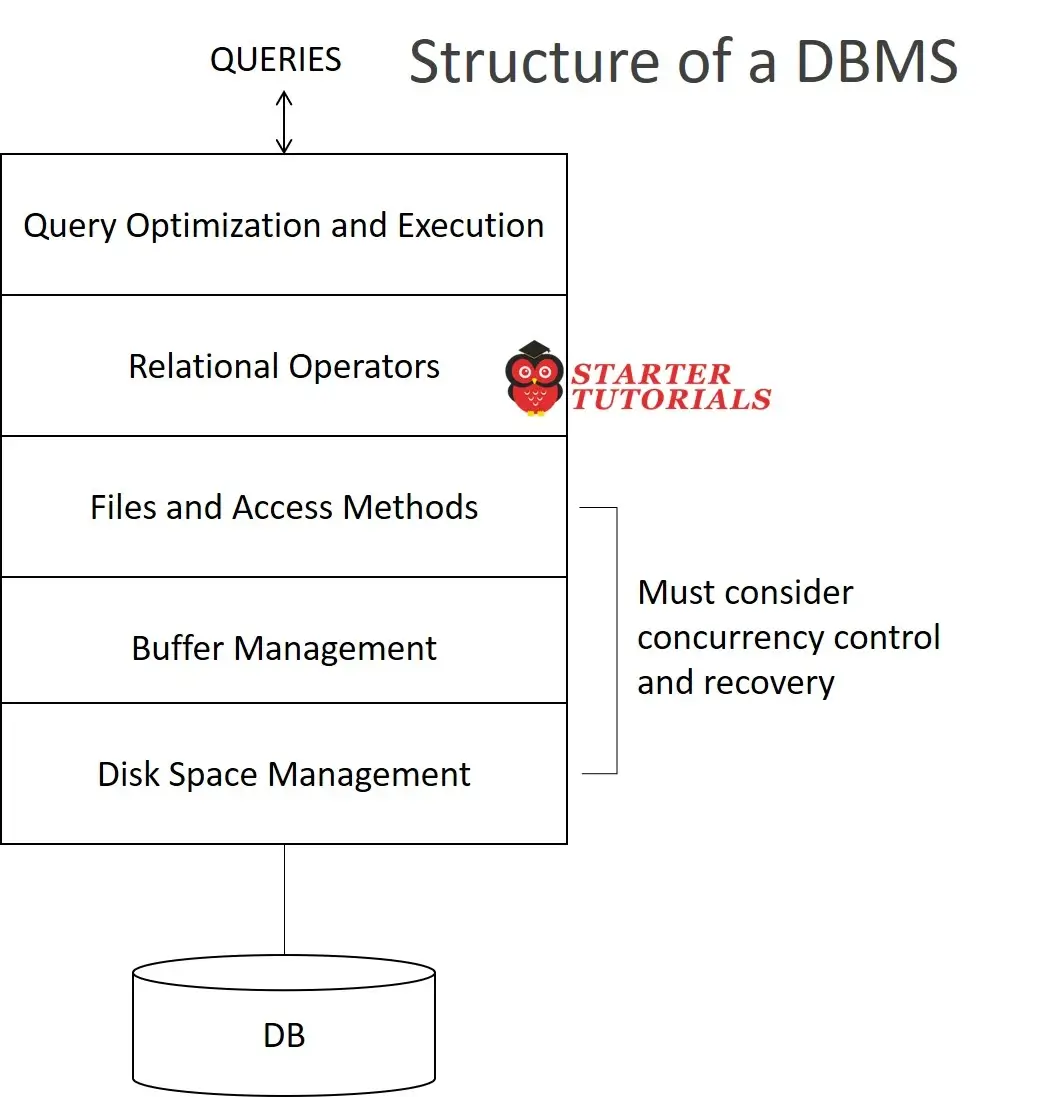
Components of a DBMS
The structure of a DBMS contains the following components:
- Disk space management
- Buffer management
- File and access methods
- Relational operators
- Query optimization and execution
Let’s look at each of the above DBMS components in detail along with examples.
Disk space management
- Role: The lowest layer that directly interacts with the operating system or raw hardware to manage physical storage space.
- Mechanism: Allocates and deallocates continuous blocks of disk space (pages, typically 4KB or 8KB), keeps track of free vs. used disk pages, and provides read/write block abstractions to the Buffer Manager.
- Example: When inserting 10,000 new rows, the Disk Space Manager requests new contiguous sectors from the OS storage drive to extend the database file allocation.
Buffer management
- Role: Manages the main memory (RAM) buffer pool to minimize expensive disk I/O operations.
- Mechanism: Loads required disk pages into RAM pages (frames). When the buffer pool fills up, it uses cache replacement algorithms (such as LRU – Least Recently Used or Clock) to decide which modified (“dirty”) pages must be written back to disk before being evicted.
- Example: If a query frequently reads student records, the Buffer Manager keeps those data pages pinned in RAM so subsequent queries fetch them instantly without touching the physical disk.
File and access methods
- Role: Bridges higher-level relational concepts (tables, rows, columns) with lower-level physical storage units (pages and blocks).
- Mechanism: Organizes records into file structures (e.g., heap files, sorted files) and manages search structures like B+ Trees and Hash Indexes to locate specific records quickly without loading entire tables.
- Example: A B+ Tree index allows the system to find a row by primary key (e.g., ID = 1042) in steps instead of scanning every page on the disk.
Relational operators
- Role: Implements the core mathematical building blocks of relational algebra required to execute query plans.
- Mechanism: Handles logic for algorithms such as joins (nested loop, hash join, sort-merge), selections, projections, and aggregations, pulling data streams from lower storage access layers.
- Example: When joining an Employees table with a Departments table, a Hash Join operator builds an in-memory hash table of department IDs to quickly match employee records.
Query optimization and execution
- Role: Acts as the top layer that accepts declarative queries (like SQL), determines the fastest execution path, and coordinates the execution steps.
- Mechanism: The optimizer evaluates multiple execution strategies using relational algebra, estimates their computational cost based on stored statistics, and passes the cheapest plan to the execution engine.
- Example: For SELECT * FROM Students WHERE Age = 20, the optimizer decides whether to scan the entire table sequentially or use an index on Age to jump straight to matching records.
A DBMS contains a few more components. DBMS components associated with concurrency control and recovery include:
- Transaction manager (ensures request and release of locks for transactions)
- Lock manager (keeps track of locks and grants locks based on need and availability)
- Recovery manager (maintains a log and takes care of database restoration to previous consistent state due to failure)

Mr. P.S.Suryateja, also known as Suryateja Pericherla, is at present a Research Scholar (full-time Ph.D.) in the Dept. of Computer Science & Systems Engineering at Andhra University, Visakhapatnam. Previously worked as an Associate Professor in the Dept. of CSE at Vishnu Institute of Technology, India.
He has 14+ years of teaching experience and is an individual researcher whose research interests are Cloud Computing, Internet of Things, Computer Security, Network Security and Blockchain.
He is a member of professional societies like IEEE, ACM, CSI and ISCA. He published several research papers which are indexed by SCIE, WoS, Scopus, Springer and others.
Leave a Reply