
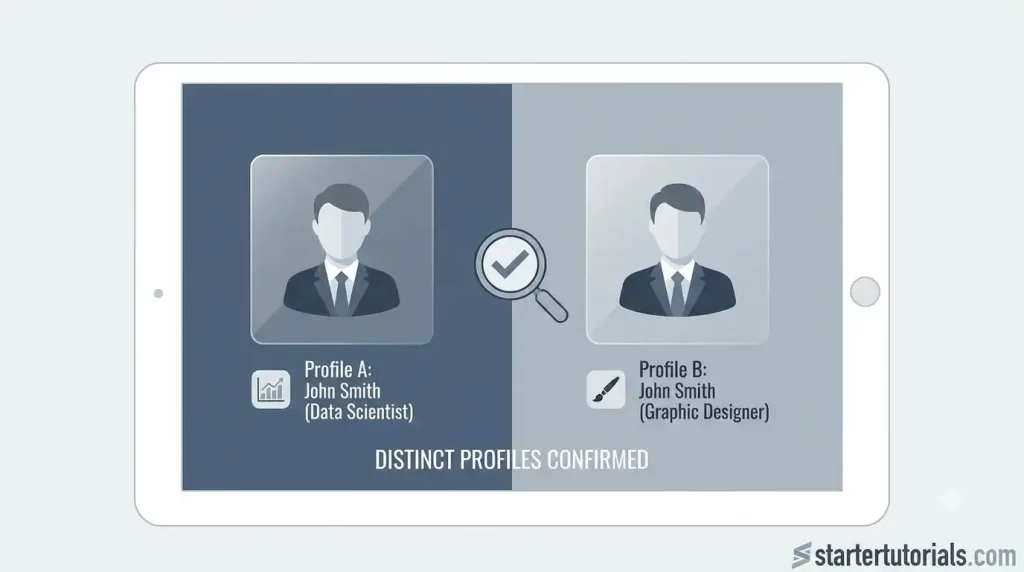
Matching professional social profiles starts with a clear purpose and several independent clues about the person. Compare employer history, professional work, and self-linked pages before accepting a match. Keep uncertain profiles separate. A similar name, photo, or username can support further research, but none of those clues proves identity by itself.
Salespeople, recruiters, and partnership researchers often encounter incomplete profile records. A conference speaker page might name a person and company without linking to a current profile. A candidate might use a shortened name on one platform. The useful question concerns whether the professional records refer to the same person for the intended task.
Choose a tool after defining the search
The LinkFinderAI guide to social media finder tools offers a starting point for comparing search approaches. Choose an approach that fits the identifier you already have. A known professional profile calls for a different check from a common name with no confirmed employer.
Write the purpose before collecting more information. A recruiter confirming a portfolio needs evidence about professional work and identity. A partnership manager may need a current role at a company. Those tasks rarely require a complete map of someone’s personal accounts. Keep the research within the professional purpose you can explain.
Begin with sources the person controls or has clearly associated with their work. A personal portfolio may link directly to a professional profile. A company biography may identify a current role. Direct links provide stronger evidence than a search result that merely places the same name beside the same industry.
Compare clues and record contradictions
Look for agreement across professional history, projects, and dates. One profile may show a previous employer while another shows a recent move. That difference can be reasonable, but it deserves a note. A contradictory city or employer does not automatically prove a mismatch, especially when someone works remotely or holds several roles.
Useful clues include:
- A direct link between two professional pages.
- Matching project names or published work.
- An employment history that makes chronological sense.
- Consistent professional affiliations supported by dated sources.
Avoid collecting unrelated personal details to make a weak match feel stronger. If the professional evidence remains unclear, mark the record unresolved. A small amount of uncertainty in the database is preferable to an incorrect association that later appears in an outreach message or hiring discussion.
Keep contact lookup downstream of identity checks
Once you have selected the intended professional profile, extensions for Chrome can support contact research. Keep that stage separate from identity matching. Returned contact information does not establish that two social profiles belong to the same person.
The same separation matters when writing outreach. Refer to the professional source that made the message relevant. Avoid mentioning unrelated accounts or implying a relationship you have not established. A short, accurate reason for contacting someone gives the recipient a fair basis for deciding whether to respond.
| Evidence | What it supports | What remains open |
| Direct profile link | A stated association | Whether it is current |
| Matching project | Professional connection | Exact responsibility |
| Shared name | A possible match | Identity confirmation |
| Contact lookup result | A possible contact route | Role and suitability |
Use a repeatable matching procedure
- Save the original source and the professional purpose of the search.
- Find a likely profile using the identifiers you already know.
- Compare at least two relevant professional clues and note disagreements.
- Classify the match as supported, unresolved, or incorrect.
- Request contact details only for profiles that meet the team’s acceptance rule.
Imagine two designers with the same name. One has a portfolio linked from a conference biography and shows the project described in that biography. The other shares the job title but works in a different field. The linked portfolio and project history support the first match. The name alone would have left both plausible.
Give the next researcher enough evidence
Save a short explanation beside the accepted profile URL. Include the source, check date, and reason for the decision. That note lets another colleague review the match without repeating the entire search. It also makes later corrections easier when a person changes companies or updates their public profiles.
Check whether the source itself identifies the account as professional and current. An old event biography can retain a valid link while describing a role the person has left. Keep the link evidence and the employment claim separate in your note.
Do not treat a completed match as permanent. Recheck the fields that matter when the record returns to active use. For your next research task, write one sentence explaining the professional evidence behind the match before adding another contact field.

Leave a Reply