
Introduction to DBMS
Every app you use, website you visit, and online service you interact with relies on a way to organize and store information. But how do we go from raw, everyday facts to the smart systems that power global applications?
In this beginner-friendly guide/tutorial, you will learn the fundamentals of Database Management Systems (DBMS) step by step. We will break down what data actually is, explore how collecting it forms a database, and discover how a DBMS helps us store, search, and secure information efficiently.
Whether you are completely new to tech or building a foundation for computer science, this tutorial will give you a clear understanding of how databases work in the real world.
What is Data?
Data is a collection of pieces of information or raw facts gathered from observation, measurement, research or analysis.
Data may consist of facts, numbers, names, figures or even description of things.
Examples of data are:
- List of student roll numbers
- List of student names
- List of student name, height and weight
- Student marks/result
- Student attendance
- List of items in a store
Let’s solidify our understanding of what is data with the help of an example. Consider a class of students. For each student in the class let’s say we are measuring the height and weight of the student. We can say that each item like name of the student (Becky), her height (5’1″) and her weight (52) can be considered as data. This is illustrated in the figure below:
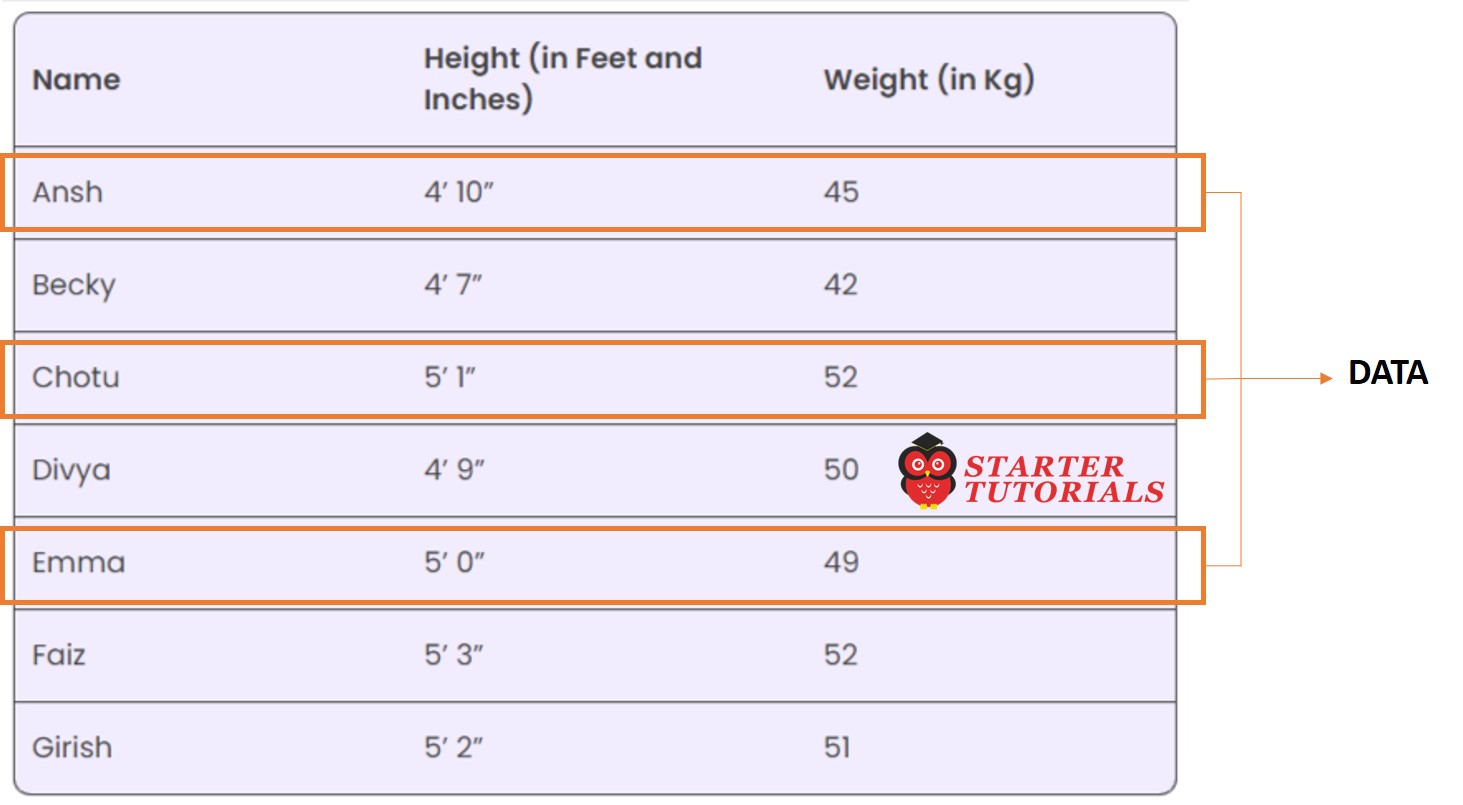
If we have only data, we can’t do much about it. If we can organize the data in the form of a database, we can infer some meaningful information. Now, let’s learn about a database.
What is a Database?
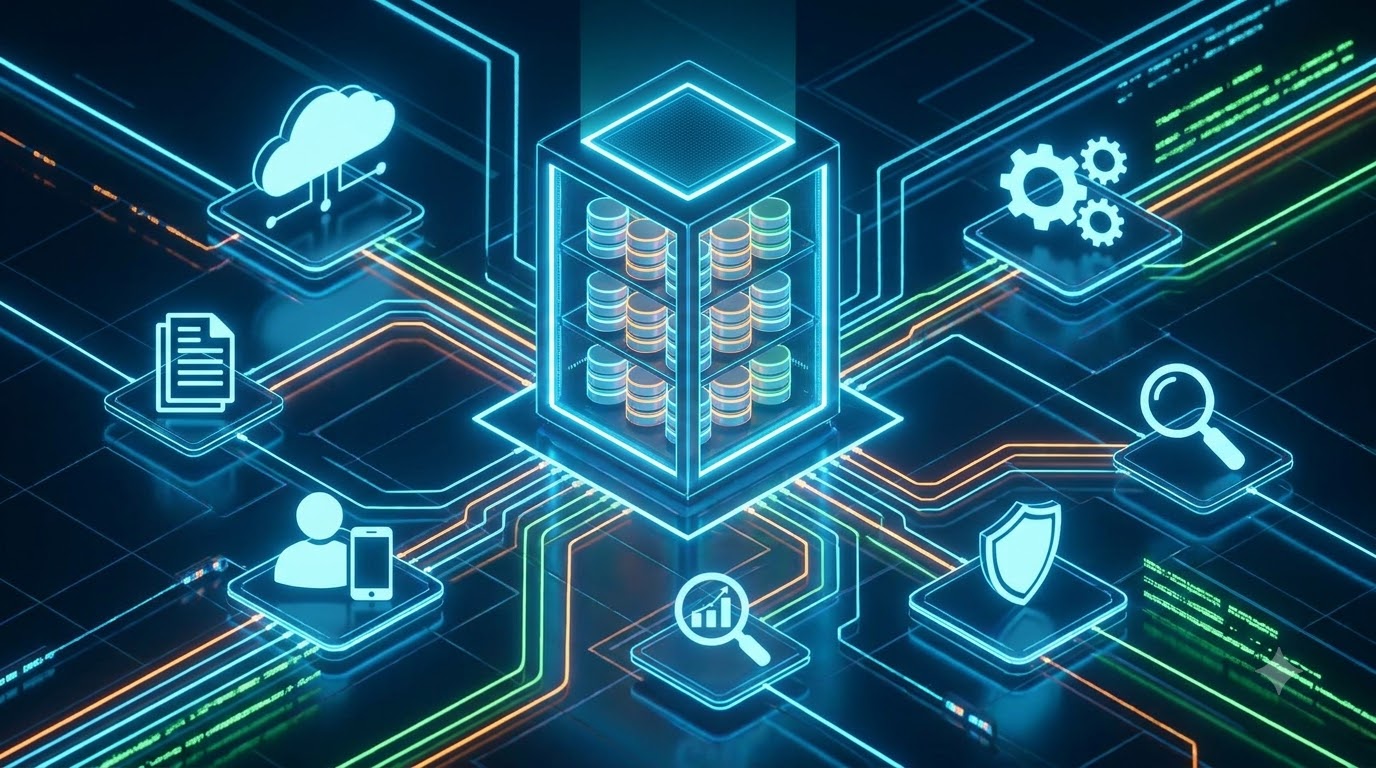
A database is a collection of related data.
The data in the database belongs to one or more related organizations.
For example, consider an university database. The entities in this database are students, faculty, courses, classrooms, etc. The relationships between these entities are enrollment, teaching, etc.
In the earlier example of student data, we can combine the details of all the students in a class and call it a database. It is as illustrated in the figure below:
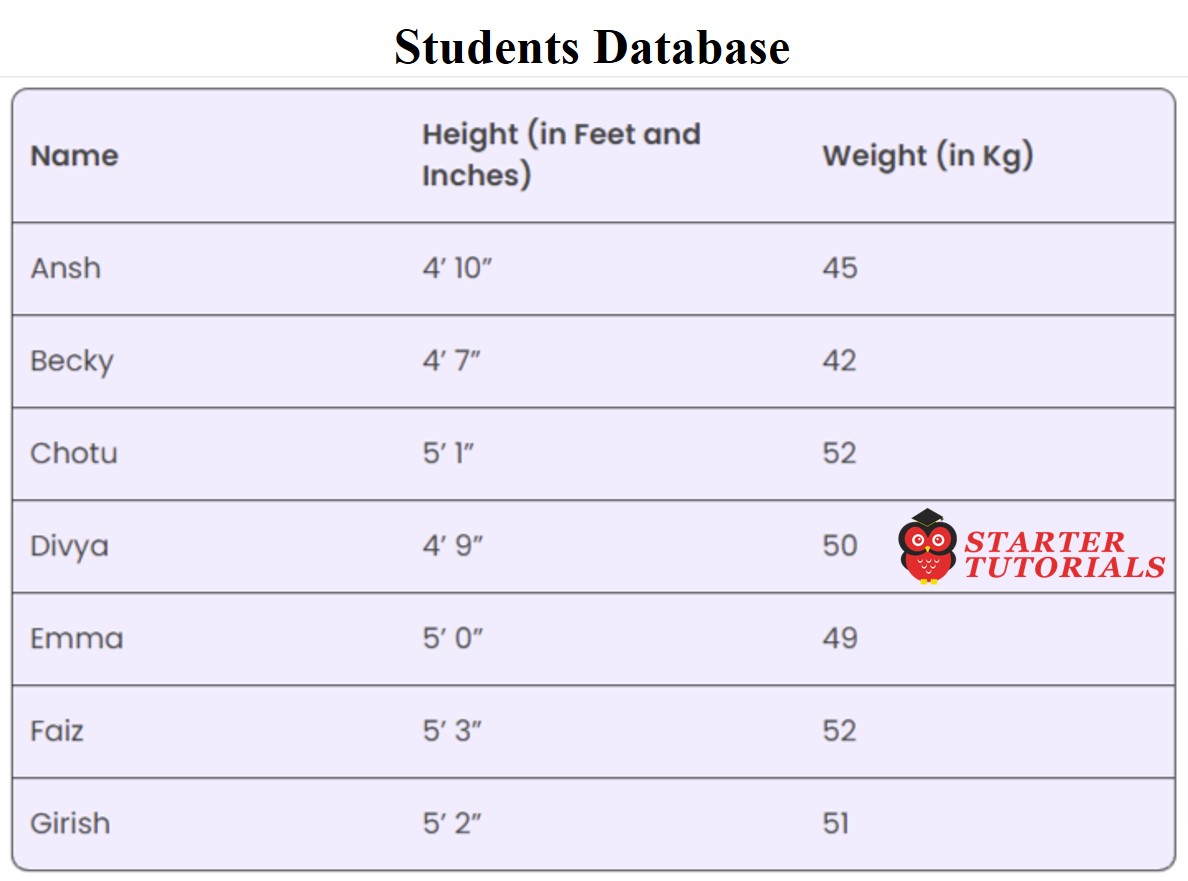
With a database we can gain new information like the average height of the class, the average weight of the class, highest weight in the class, and so on.
What is a DBMS?
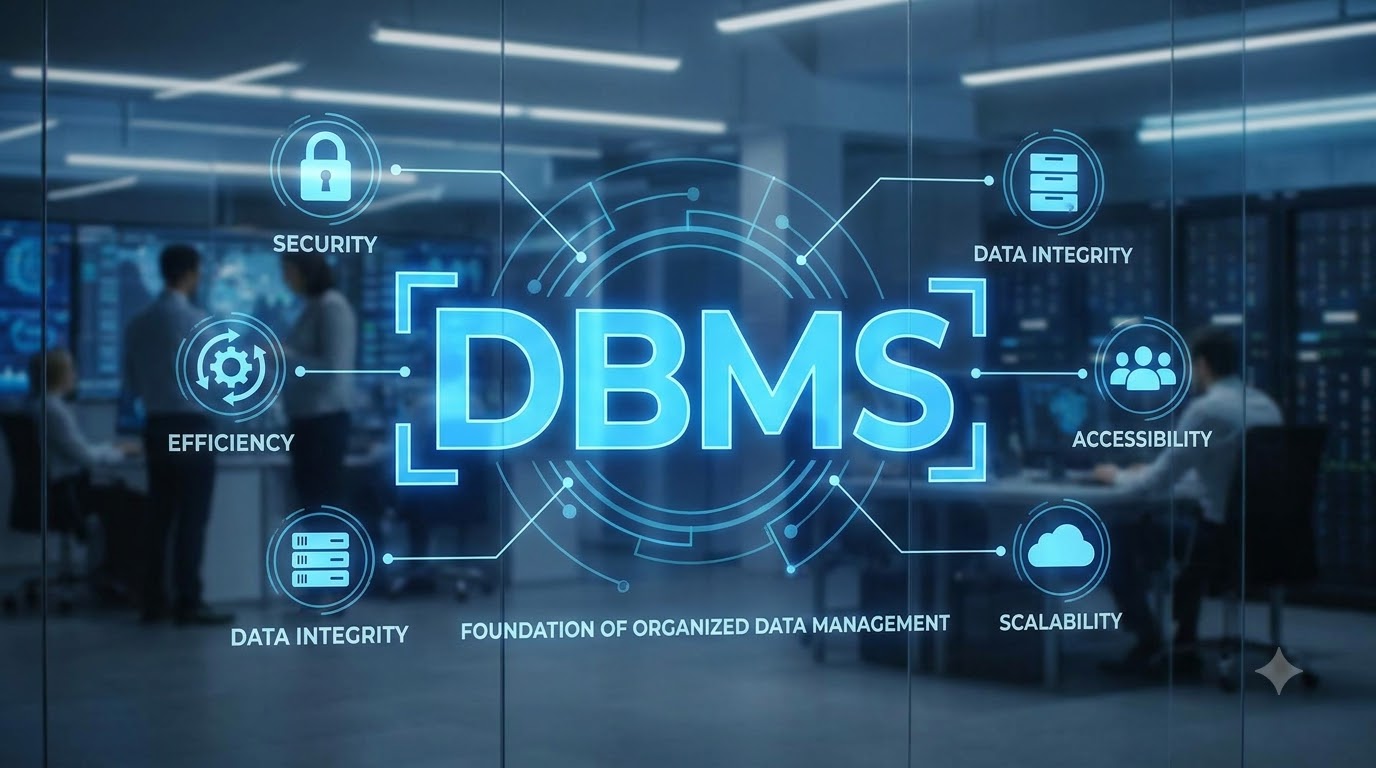
A DBMS is a software designed to help for maintaining and utilizing large collections of data.
Functions of a DBMS
A DBMS can perform the following:
- Data definition (create)
- Data retrieval
- Data manipulation (insert, update, delete)
- Access control (security)
- Data integrity
- Backup and recovery
- Concurrency control
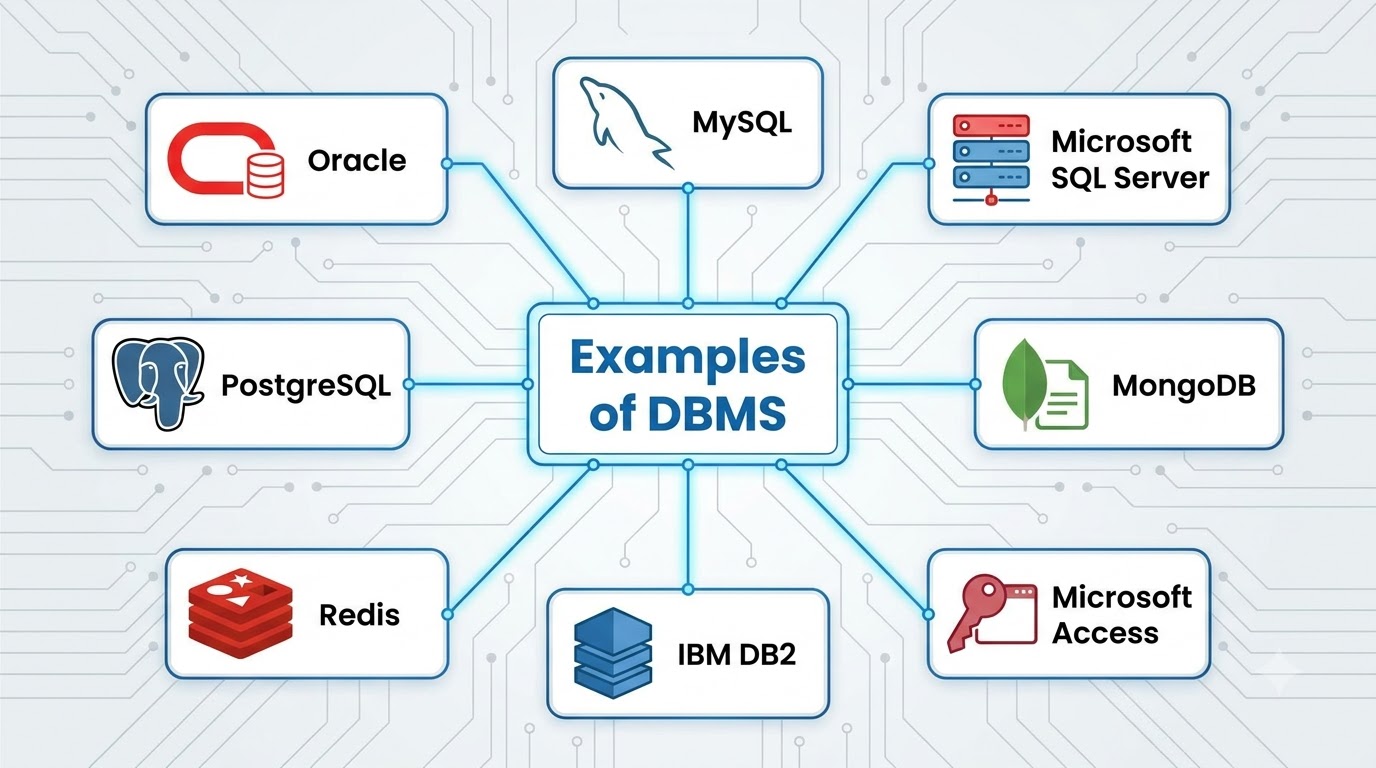
Examples of DBMS
Different examples of DBMS are:
- Oracle
- MySQL
- Microsoft SQL Server
- PostgreSQL
- MongoDB
- Redis
- IBM DB2
- Microsoft Access
Why a DBMS is required?
A Database Management System (DBMS) is software that sits between applications/users and the raw data, acting as a central manager to store, retrieve, and secure information efficiently.
Without a DBMS, applications rely on traditional file-processing systems (like storing data in spreadsheets or raw .txt files), which quickly break down as data grows.
A DBMS offers following core capabilities:
- Data Integrity and ACID Guarantees
- Concurrent Access & Crash Recovery
- Automated Backup and Maintenance
Types of DBMS
The evolution of data models and how data is structured has led to various types of DBMS. Frequently used types of DBMS are:
- Relational database management systems (RDBMS)
- Object-oriented DBMS (OODBMS)
- Hierarchical DBMS (HDBMS)
- Network DBMS (NDBMS)
- Columnar database management systems (CDBMS)
- NoSQL databases
Source: https://www.bmc.com/blogs/dbms-database-management-systems/
Applications of DBMS
A DBMS is used wherever there is a need to store data and manipulate that data. Some of the example systems or applications where a DBMS is used are:
- Banking
- Universities
- Insurance
- Broadcasting
- Human Resource Management
- Manufacturing
- Telecommunication
- Airline Reservation
- Railway Reservation
- Industries
- Accounting and Finance
- Medical
- E-commerce
- Library Management
- Social Media

Mr. P.S.Suryateja, also known as Suryateja Pericherla, is at present a Research Scholar (full-time Ph.D.) in the Dept. of Computer Science & Systems Engineering at Andhra University, Visakhapatnam. Previously worked as an Associate Professor in the Dept. of CSE at Vishnu Institute of Technology, India.
He has 14+ years of teaching experience and is an individual researcher whose research interests are Cloud Computing, Internet of Things, Computer Security, Network Security and Blockchain.
He is a member of professional societies like IEEE, ACM, CSI and ISCA. He published several research papers which are indexed by SCIE, WoS, Scopus, Springer and others.
Leave a Reply