
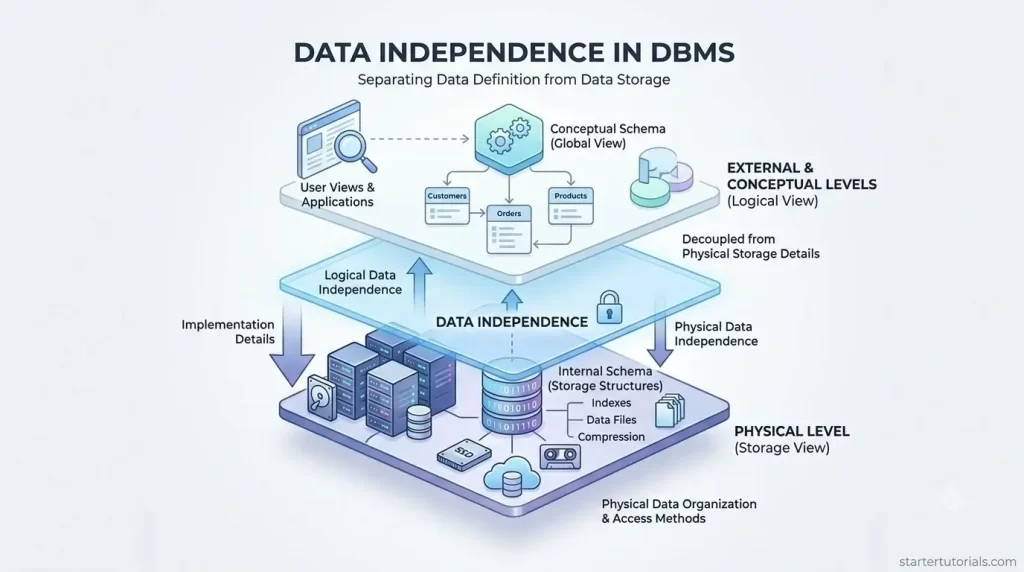
Data independence in DBMS is a foundational concept that dictates how modern database architectures separate application code from underlying data structures. Understanding the role of data independence in database management systems helps developers and database administrators (DBAs) design resilient systems that minimize maintenance overhead, protect sensitive data, and support seamless infrastructure upgrades.
What is data independence?
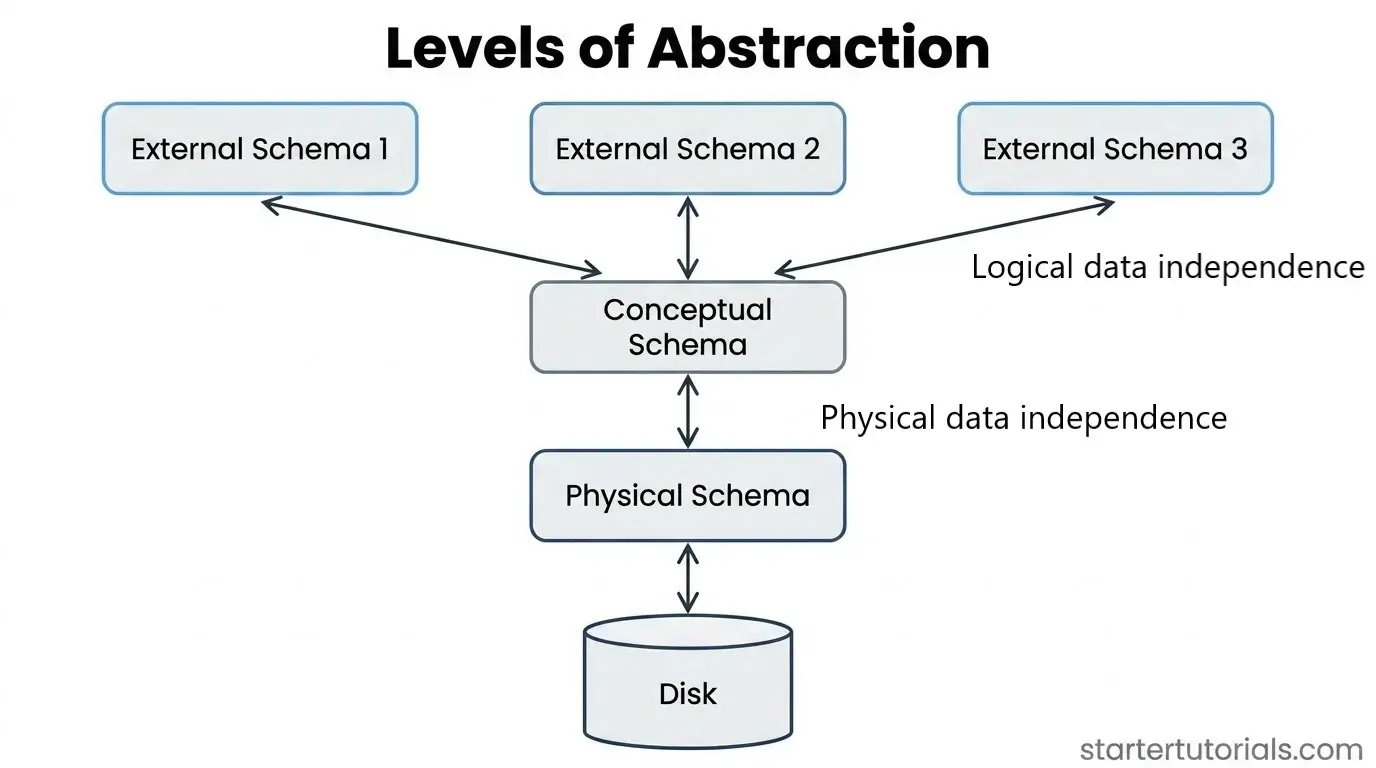
Data independence refers to the isolation of application programs from changes in the structure and storage of data. It is achieved through the use of the three levels of abstraction.
Think of it like a smart TV app: if Netflix updates how its servers store video files in the cloud, you don’t need to buy a new TV or update how you navigate the user interface. The data behind the scenes changed, but your interaction with it stayed exactly the same.
Uses of data independence
Data independence simplifies database management by separating how data is stored and structured from how applications and end-users interact with it. The uses or core benefits of data independence are:
- Reduced Maintenance Costs: Developers do not need to rewrite application code every time the underlying database structure or hardware changes.
- Seamless Upgrades: System administrators can change physical storage (e.g., migrating to faster SSDs, adding cloud storage, or indexing columns) without causing system downtime or breaking client applications.
- Enhanced Data Security: Users and applications only access specific “views” of the data rather than the entire raw database, hiding sensitive structural details.
- System Flexibility: Database administrators (DBAs) can freely alter the logical schema—such as adding a new user attribute or expanding a table—without disrupting existing programs that rely on the old structure.
- Simplified Development: Software developers can build applications focusing purely on business logic rather than worrying about physical storage or low-level file management details.
Types of data independence
There are two main types of data independence in a Database Management System (DBMS):
- Logical data independence
- Physical data independence
Logical data independence
The isolation of users from the changes in the logical structure of data or changes in the choice of relations is called as logical data independence.
Some examples of logical data independence are:
- Without rewriting current application scripts, you can add, modify, or delete a new attribute, entity, or relationship.
- To divide an existing record into two or more records.
- Merging two records into a single one.
If there is a database of a banking system and we want to add the details of a new customer or we want to update or delete the data of a customer, at the logical level data will be changed but it will not affect the user.
Physical data independence
The isolation of users from the changes in the physical storage of data is called as physical data independence.
For example, if we take the database of the banking system and we want to scale up the database by changing the storage size and also want to change the file structure, we can do it without affecting any functionality of logical schema.
Some more examples of physical data independence are:
- Changing from one data structure to another.
- Making use of new storage technology, such as a hard drive or magnetic tapes.
- Change the location of the database from one drive to another.
- Changing the database’s file organization.
Differences between logical and physical data independence
The two levels of data independence in a DBMS are logical data independence and physical data independence. The differences between logical and physical data independence are given in the table below:
| Feature / Aspect | Logical Data Independence | Physical Data Independence |
|---|---|---|
| Definition | The ability to modify the logical/conceptual schema without altering external schemas or application programs. | The ability to modify the physical/internal schema without altering the logical/conceptual schema. |
| Database Level | Operates between the Conceptual Level and the View (External) Level. | Operates between the Internal (Physical) Level and the Conceptual Level. |
| Ease of Achievement | Difficult to achieve, as application programs are tightly coupled to the logical structure of data. | Relatively easy to achieve, as user applications rarely interact with physical storage details. |
| Focus | Focuses on the structure and relationships of the data (entities, attributes, and constraints). | Focuses on how data is physically stored, indexed, and retrieved on storage devices. |
| Typical Changes | Adding/deleting a table, adding new attributes, or modifying logical constraints. | Switching storage hardware (e.g., HDD to SSD), creating indexes, or changing file organization methods. |
| Impact on Code | Protects application logic when business rules or entity attributes evolve. | Protects the logical schema and applications when performance tuning or storage updates occur. |
Advantages of data independence
The advantages of data independence are:
- Simplified Maintenance: Modifications to backend storage or database structures can be made without rewriting application code or user interfaces.
- Cost and Time Savings: Developers spend less time refactoring existing programs when database hardware upgrades or schema changes occur.
- Enhanced System Flexibility: Database Administrators (DBAs) can optimize storage performance, rebuild indexes, or partition tables without interrupting daily user workflows.
- Improved Security and Privacy: Applications only interact with specific logical views, insulating sensitive physical storage details and unauthorized data from end-users.
- Data Integrity and Consistency: Enforcing constraints at the logical layer keeps data accurate across all connected systems, even when underlying storage formats change.
- Streamlined Application Development: Software engineers can focus on core business logic rather than low-level physical file structures or storage mechanisms.
Disadvantages of data independence
The disadvantages of data independence are:
- Increased System Complexity: Maintaining multiple abstraction layers (external, logical, and physical) requires additional software mapping and architecture, making the overall DBMS design far more complex.
- Performance Overhead: Every data request must pass through translation layers between application views, logical structures, and physical storage. This abstraction layer introduces computational latency compared to direct, hard-coded data access.
- Higher Hardware and Resource Demands: Processing the translation mappings and managing structural metadata requires extra CPU power, memory, and storage, raising infrastructure requirements.
- Difficult Implementation and Maintenance: Designing a fully independent database system is technically challenging. Database Administrators (DBAs) must manage complex mappings and schema configurations to ensure independence holds up as systems scale.
- Reduced Fine-Grained Performance Control: Because application developers are completely isolated from physical storage mechanics, they cannot write hyper-optimized, hardware-level access queries for specialized tasks.

Mr. P.S.Suryateja, also known as Suryateja Pericherla, is at present a Research Scholar (full-time Ph.D.) in the Dept. of Computer Science & Systems Engineering at Andhra University, Visakhapatnam. Previously worked as an Associate Professor in the Dept. of CSE at Vishnu Institute of Technology, India.
He has 14+ years of teaching experience and is an individual researcher whose research interests are Cloud Computing, Internet of Things, Computer Security, Network Security and Blockchain.
He is a member of professional societies like IEEE, ACM, CSI and ISCA. He published several research papers which are indexed by SCIE, WoS, Scopus, Springer and others.
Leave a Reply