Starter Tutorials Blog
Tutorials and articles related to programming, computer science, technology and others.
Subscribe to Startertutorials.com's YouTube channel for different tutorial and lecture videos.
Home » Computer Science » Page 2
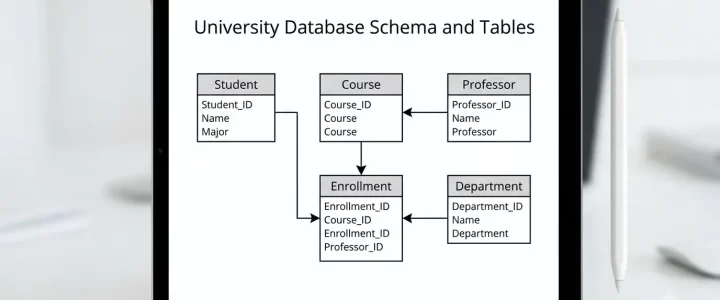
University Database Schema and Tables

University Database Schema and Tables

Suryateja Pericherla Categories: DBMS. No Comments on University Database Schema and Tables

Having a cohesive and uniform example schema and tables is much essential to understand SQL queries. To make it happen, here we present a university database schema and the associated tables.   University database ER diagram The ER diagram (conceptual design) for a university information management application is shown in the image below:   University […]
Read the rest of this entry »
SQL Commands with Examples

SQL Commands with Examples: Complete Quick Reference Guide

Suryateja Pericherla Categories: DBMS. No Comments on SQL Commands with Examples: Complete Quick Reference Guide

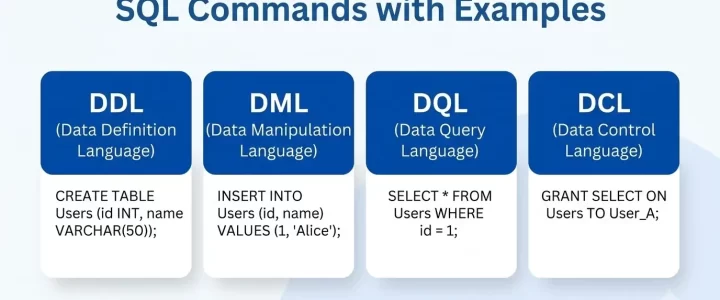
Mastering SQL commands with examples is the most effective way to understand how relational databases communicate, organize, and retrieve data. This comprehensive guide breaks down all core SQL statement categories, including DDL, DML, DQL, DCL, and TCL using a unified university database schema so you can easily learn, apply, and refine your database management skills. […]

Read the rest of this entry »
Introduction to SQL

Introduction to SQL: The Complete Guide to Relational Databases

Suryateja Pericherla Categories: DBMS. No Comments on Introduction to SQL: The Complete Guide to Relational Databases

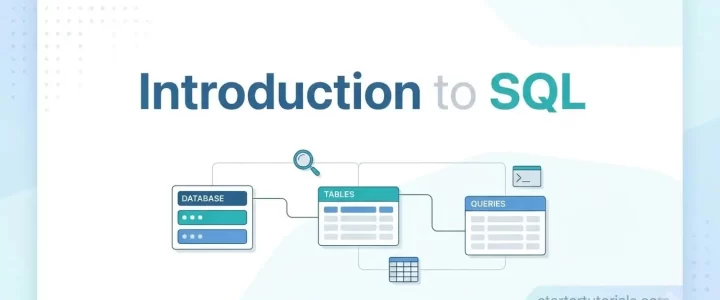
Every modern digital application relies on stored information, and understanding the basics of database management starts with a proper introduction to SQL. SQL, or Structured Query Language, is the universal language designed for communicating with relational database management systems (RDBMS).   Whether you are exploring SQL fundamentals, learning database query basics, or getting an overview […]

Read the rest of this entry »
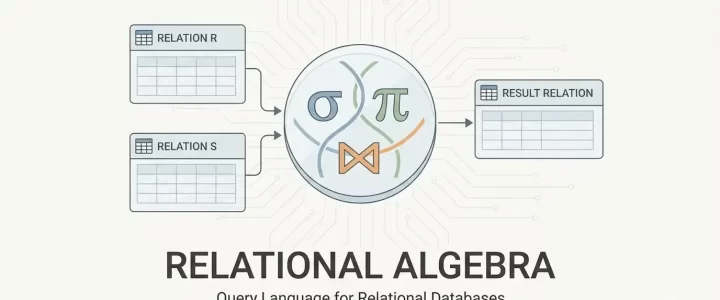
Relational Algebra in DBMS

Understanding Relational Algebra in DBMS: A Simple Guide

Suryateja Pericherla Categories: DBMS. No Comments on Understanding Relational Algebra in DBMS: A Simple Guide

Relational algebra in DBMS is the mathematical foundation behind relational databases, providing the core rules for querying and manipulating structured data. Understanding relational algebra operations gives you a clear mental model of how database management systems process requests under the hood.   What is relational algebra? Relational algebra in a Database Management System (DBMS) is […]

Read the rest of this entry »
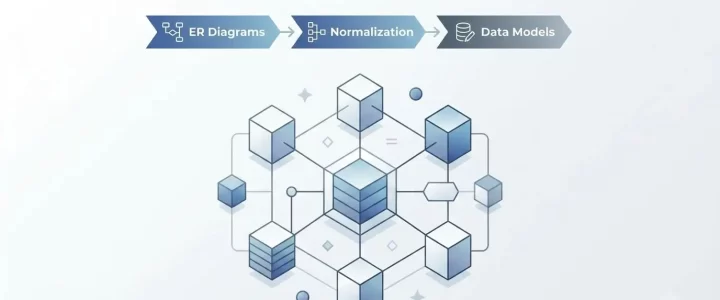
Logical Database Design

Logical Database Design: A Complete Guide with Examples

Suryateja Pericherla Categories: DBMS. No Comments on Logical Database Design: A Complete Guide with Examples

In database management, logical database design is the crucial bridge that turns abstract business ideas into a structured, real-world data system. Whether you call it logical data modeling, database schema design, or relational schema mapping, this process focuses entirely on organizing your data efficiently and defining relationships clearly without getting bogged down by specific software, […]

Read the rest of this entry »
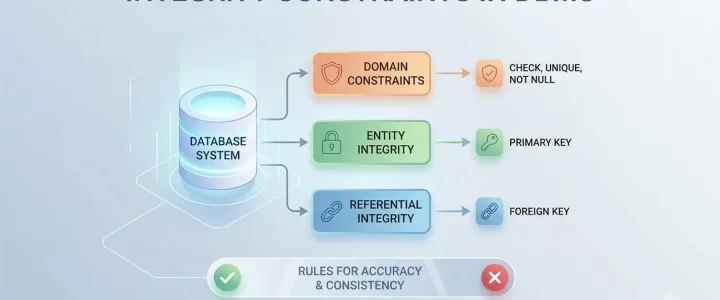
Integrity Constraints in DBMS

Understanding Integrity Constraints in DBMS – Types & Examples

Suryateja Pericherla Categories: DBMS. No Comments on Understanding Integrity Constraints in DBMS – Types & Examples

In any relational database system, maintaining clean, reliable, and error-free data is essential for accurate operations. Integrity constraints in DBMS act as foundational rules that automatically protect your tables from duplicate entries, invalid values, and broken relationships.   Whether referred to as database integrity rules, data constraints in SQL, or DBMS data validation rules, these […]

Read the rest of this entry »
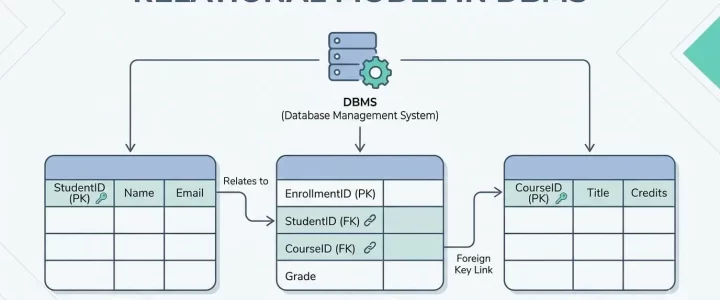
Relational Model in DBMS

Relational Model in DBMS: Concepts and Example

Suryateja Pericherla Categories: DBMS. No Comments on Relational Model in DBMS: Concepts and Example

Managing massive amounts of data efficiently requires a clear, reliable structure. The relational model in DBMS provides this foundation by organizing complex information into straightforward, interconnected tables.   As the standard architecture for modern Relational Database Management Systems (RDBMS), this data organization model relies on clear relationships, keys, and logical rules to keep data secure […]

Read the rest of this entry »
Additional Features of ER Model

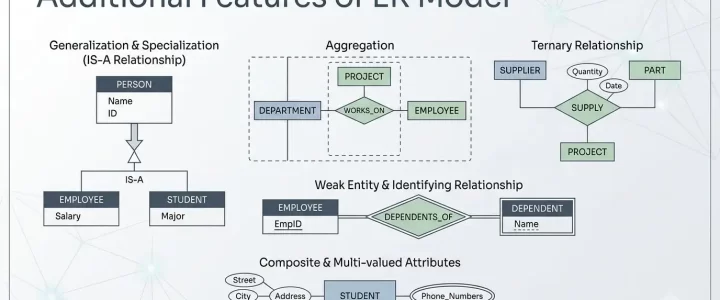
Additional Features of ER Model: Capturing Complex Business Rules

Suryateja Pericherla Categories: DBMS. No Comments on Additional Features of ER Model: Capturing Complex Business Rules

While standard Entity-Relationship diagrams cover the basics of database design, real-world data requirements often demand more nuanced controls. Understanding the additional features of ER model systems helps you capture complex business rules directly within your conceptual schema.   Need for additional features Standard Entity-Relationship (ER) models use basic building blocks like simple entities, attributes, and […]

Read the rest of this entry »
ER Model Basic Concepts

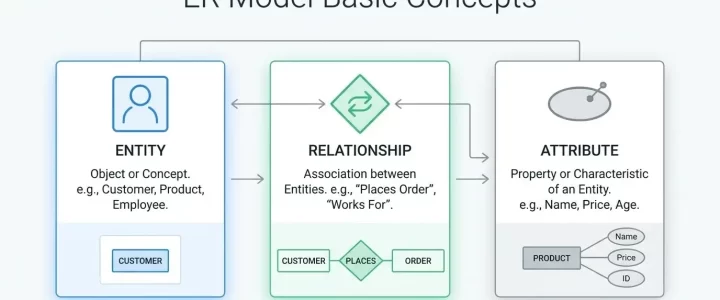
ER Model Basic Concepts: A Beginner’s Guide to Database Design

Suryateja Pericherla Categories: DBMS. No Comments on ER Model Basic Concepts: A Beginner’s Guide to Database Design

Before building a complex database, you need a clear visual blueprint to organize your data and prevent costly design mistakes. Learning ER model basic concepts gives you the foundational tools to map out real-world information using standard Entity-Relationship modeling fundamentals.   In this tutorial, we will break down the essential components of an ER diagram, […]

Read the rest of this entry »
Database Design in DBMS

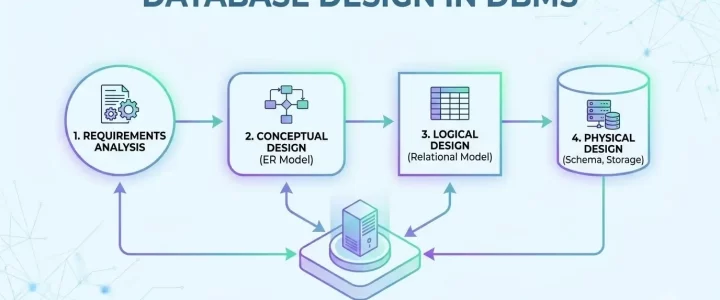
Database Design in DBMS: Complete Guide, Phases & Examples

Suryateja Pericherla Categories: DBMS. No Comments on Database Design in DBMS: Complete Guide, Phases & Examples

Mastering database design is the most critical first step in building fast, scalable, and reliable applications. Whether you are crafting a simple data model, establishing a robust relational schema, or planning your system’s underlying database architecture, how you organize and structure your information dictates how smoothly your system will run.   In this comprehensive guide, […]

Read the rest of this entry »
Facebook
Twitter
Pinterest
Youtube
Instagram
Blogarama - Blog Directory