
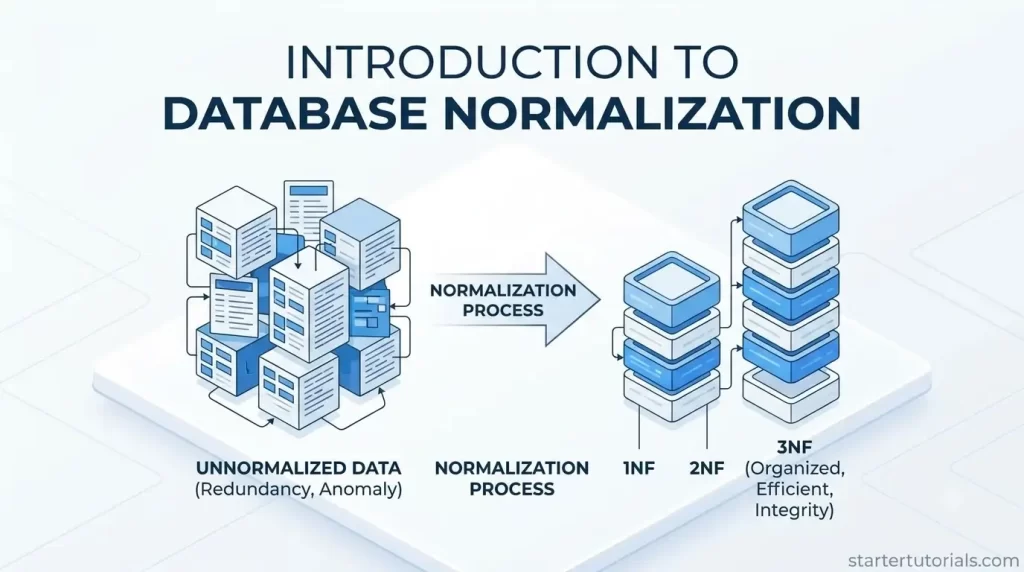
Database normalization is the cornerstone of designing clean, reliable, and efficient relational databases. If you are new to backend development or database management, getting a solid introduction to database normalization is essential for understanding how raw information is structured into organized, high-performing systems.
At its core, normalizing a database involves organizing data models, eliminating redundant entries, and structuring tables so that every piece of information relies on a clear logical key. By exploring the fundamental concepts of relational database normalization, from basic data structuring guidelines to standard normal forms, this tutorial will guide you through turning cluttered, error-prone tables into a scalable and reliable data architecture.
What is database normalization?
Database normalization is the process of organizing data in a database to eliminate redundant, duplicate information and ensure related data is stored logically.
Normalization splits one large, cluttered table into smaller, specialized tables (like separate tables for “Customers,” “Orders,” and “Products”) and links them together using unique identification codes.
This clean structure prevents storage waste, ensures that updating a piece of information (like a customer’s address) only needs to be done once, and keeps all the data accurate and reliable.
Need for normalization
Without normalization, storing data in a single large table leads to severe disorganization, unnecessary bulk, and data corruption risks.
Normalization solves four major problems:
- Eliminating Data Redundancy: Prevents saving the exact same information over and over again. For instance, instead of writing a customer’s full address on every single order line, you store the address once and refer to it by a short Customer ID.
- Preventing Update Anomalies: Ensures you only have to change information in one place. If a customer moves, updating their address in a normalized database takes one edit. In an unnormalized database, you would have to search and update dozens of individual order entries, risking missed entries and mismatched data.
- Avoiding Insertion Anomalies: Allows you to record new details independently. For example, you can add a new product to your inventory database even if no customer has purchased it yet. In an unnormalized system, you might be forced to create a fake customer or order just to list a new item.
- Avoiding Deletion Anomalies: Prevents accidental loss of vital information. If you delete a canceled order in an unnormalized system, you might accidentally erase the only copy of the customer’s contact details or the product’s price history along with it.
Normalized databases ensure every piece of data lives in exactly one correct location, keeping data accurate, consistent, and easy to maintain.
Uses of database normalization
Database normalization is used to make managing and storing data efficient, secure, and reliable. Here are the primary practical uses:
- Saving Storage Space: By removing duplicate entries, normalization keeps tables lean and prevents databases from bloating with repetitive text.
- Simplifying Updates and Maintenance: Changing information—like updating a product’s price or a user’s phone number—only requires editing a single record instead of hunting down hundreds of duplicate rows.
- Enforcing Data Consistency and Accuracy: Because information exists in only one official location, you never end up with conflicting records (such as two different phone numbers listed for the same customer).
- Improving Data Security and Access Control: Splitting data into specialized tables allows administrators to set specific permissions. For instance, employees can be given access to view “Order History” without gaining access to sensitive “Payment Details.”
- Accelerating Database Maintenance: Standard tasks like backing up data, running system checks, and restructuring tables happen much faster on well-organized, smaller tables than on massive, cluttered ones.
Implementing normalization and normal forms
Implementing normalization involves taking an unorganized, cluttered table and breaking it down into smaller, well-structured tables using a step-by-step process known as Normal Forms.
What is a normal form?
A normal form is a set of rules or standard guidelines used in database design to determine how well-organized and clean a table is.
Think of normal forms like progressive grade levels in school: each level sets specific requirements for how data should be structured, and to reach a higher level, your database must first pass all the tests of the levels before it. Starting from First Normal Form (1NF) up to higher levels like Third Normal Form (3NF) or Boyce-Codd Normal Form (BCNF), each rule systematically targets and removes specific types of clutter, duplicate information, and data errors.
Different normal forms
Here are the main normal forms used in database design, listed in order from the basic foundational levels to the more advanced stages:
- First Normal Form (1NF) – One value per cell: Requires that every table cell contains only a single piece of data (no lists or grouped values) and that every row is uniquely identifiable.
- Second Normal Form (2NF) – No partial dependencies: Builds on 1NF by ensuring that all descriptive information in a row depends on the entire main identifier (Primary Key), not just a part of it.
- Third Normal Form (3NF) – No transitive dependencies: Builds on 2NF by removing columns that depend on other non-key columns, ensuring data relies only on the main identifier.
- Boyce-Codd Normal Form (BCNF) – Strict 3NF: A slightly stronger variation of 3NF that cleans up edge-case overlaps when a table has multiple overlapping primary key combinations.
- Fourth Normal Form (4NF) – No multi-valued dependencies: Prevents a single record from storing two or more independent multi-valued facts about an entity in the same table (e.g., storing a person’s multiple phone numbers and multiple skill sets in one row).
- Fifth Normal Form (5NF) – No join dependencies: Deals with complex scenarios where a table is split into multiple smaller tables, ensuring it can be recombined seamlessly without losing or creating fake information.
- Domain-Key Normal Form (DKNF) – The ideal state: The theoretical ultimate level of normalization where all constraints and rules are enforced naturally by the data types and key rules alone.
Which normal form is sufficient?
In most real-world applications, Third Normal Form (3NF) is considered sufficient for database design.
Why 3NF is the Ideal Target?
- The “Sweet Spot” of Performance and Cleanliness: 3NF eliminates almost all common data duplication and update errors (like changing an address in multiple places) while keeping the database layout manageable.
- Avoids Over-Engineering: Higher levels such as 4NF or 5NF deal with extremely complex edge cases. Enforcing them usually requires splitting a database into dozens of tiny tables, which makes writing queries unnecessarily difficult and slows down system performance.
- Faster Query Speeds: Every time you split a table to reach a higher normal form, the database must perform a JOIN operation to recombine that data when reading it. 3NF strikes a practical balance between keeping data clean and keeping read speeds fast.
Example of database normalization
Here is how you implement normalization step-by-step using a simple Store Order System as an example.
Before applying normalization, an unnormalized database typically stores every piece of information customer details, order information, and item records all together in one giant flat table, Store_Orders as given below:
Store_Orders

├── Order_ID

├── Order_Date

├── Customer_Name

├── Customer_Address

├── Customer_City

├── Customer_Zip

├── Purchased_Items       (stores comma-separated values, e.g., "Laptop, Mouse")

├── Item_Prices           (stores comma-separated values, e.g., "1200, 25")

├── Quantities            (stores comma-separated values, e.g., "1, 2")

└── Total_Amount
The table Store_Orders with some sample data is shown below:
| Order_ID | Order_Date | Customer_Name | Customer_Address | Customer_City | Customer_Zip | Purchased_Items | Item_Prices | Quantities | Total_Amount |
|---|---|---|---|---|---|---|---|---|---|
| 101 | 2026-09-15 | Alice Smith | 123 Elm St | Springfield | 62701 | Laptop, Mouse, Backpack | $1200, $25, $50 | 1, 2, 2001 | $1,300 |
| 102 | 2026-09-16 | Bob Jones | 456 Oak Ave | Shelbyville | 62565 | Mouse, Keyboard | $25, $75 | 1, 1 | $100 |
| 103 | 2026-09-18 | Alice Smith | 123 Elm St | Springfield | 62701 | Monitor, Laptop | $300, $1200 | 1, 1 | $1,500 |
The key issues with the above unnormalized schema are:
- Commas in Single Cells: The Purchased_Items, Item_Prices, and Quantities columns store comma-separated lists of values inside a single cell, making it impossible to search, filter, or calculate statistics for individual items.
- Severe Redundancy: Alice Smith’s full address and name are written out repeatedly for every new order she places.
- Update Risks: If Alice moves to a new address, you must find and update every single historical order row she has ever made.
- Deletion Risks: If Bob cancels Order 102 and you delete that row, you lose all record of Bob’s customer details from the entire database.
Now let’s see the normalization process:
Step 1: First Normal Form (1NF) — Eliminate Repeating Values
- The Rule: Each cell must contain only one single value, and every record must have a unique identifier (Primary Key).
- How to Implement: If an order row lists multiple items in a single cell like “Shirts, Shoes, Socks”, separate them so that every single item gets its own row. Assign a unique ID to every order.
Step 2: Second Normal Form (2NF) — Remove Partial Dependencies
- The Rule: Every non-key column must depend on the entire Primary Key, not just part of it.
- How to Implement: Take attributes that describe specific entities and move them into their own tables.
- Create a separate Products table for product details (like product name and price) so that product info isn’t repeated every time a product is ordered.
- Create an Orders table that links Order IDs to Product IDs.
Step 3: Third Normal Form (3NF) — Remove Transitive Dependencies
- The Rule: Non-key columns must rely only on the Primary Key, not on other non-key columns (no “middleman” dependencies).
- How to Implement: If a column depends on another column that isn’t the primary key, move it.
- For example, in an Orders table, storing Customer Name, Customer Address, and Zip Code City creates indirect links (Zip Code determines City).
- Move customer information into a separate Customers table. The main Orders table then only needs a simple Customer ID.
The Resulting Structure/Schema
After implementing normalization, the single giant table (StoreOrders) transforms into clean, interconnected tables:
- Customers Table: Customer ID | Name | Address
- Products Table: Product ID | Product Name | Price
- Orders Table: Order ID | Customer ID | Order Date
- Order Line Items Table: Order ID | Product ID | Quantity
By using foreign keys (IDs referencing other tables), all data remains connected without duplicating any details.
Comparison of normal forms
The summary of normal forms is shown in the table below:
| Normal Form | Main Rule / Focus | Key Benefits | Main Drawbacks |
|---|---|---|---|
| First Normal Form (1NF) | No grouped values: Every cell must hold only one single value, and every row must have a unique identifier (Primary Key). | Makes searching, filtering, and sorting individual data items easy; eliminates complex multi-value cells. | Causes significant row duplication, leading to larger tables and repetitive data entries. |
| Second Normal Form (2NF) | No partial dependencies: Meets 1NF, and all descriptive columns must depend on the entire Primary Key (not just part of a composite key). | Reduces repetition of entity details (like product names) when items appear across multiple records. | Does not prevent non-key columns from depending on other non-key columns (e.g., city depending on zip code). |
| Third Normal Form (3NF) | No transitive dependencies: Meets 2NF, and columns must rely only on the Primary Key, eliminating indirect linkages between non-key columns. | Eliminates almost all common data duplication; ensures changing an attribute (like an address) takes just one update; ideal balance for most apps. | Requires combining multiple tables using JOIN operations, which can slow down read performance for large datasets. |
| Boyce-Codd Normal Form (BCNF) | Strict 3NF: A stronger version of 3NF that cleans up rare edge cases involving multiple overlapping composite candidate keys. | Fixes subtle redundancy anomalies that 3NF misses in complex multi-key table structures. | Can occasionally force a design that loses simple relationship constraints, requiring complex triggers to enforce. |
| Fourth Normal Form (4NF) | No independent multi-values: Meets BCNF and ensures a table doesn't store two independent multi-valued facts about an entity in one row (e.g., skills and languages). | Prevents combinatorial explosion of duplicate rows when recording multiple independent properties. | Creates very small, highly fragmented tables that complicate simple queries and table maintenance. |
| Fifth Normal Form (5NF) | Seamless recombination: Ensures a table broken into smaller parts can be recombined without creating or losing records. | Guarantees complete structural integrity in highly complex, multi-way data relationships. | Extremely complex to design and maintain; heavily degrades database performance due to excessive table joins. |
| Domain-Key Normal Form (DKNF) | Ultimate theoretical state: All rules and constraints are automatically enforced by data types and keys alone. | Represents absolute data perfection with zero redundancy or structural anomalies. | Mostly theoretical; rarely implemented in real-world databases due to extreme complexity and impracticality. |

Mr. P.S.Suryateja, also known as Suryateja Pericherla, is at present a Research Scholar (full-time Ph.D.) in the Dept. of Computer Science & Systems Engineering at Andhra University, Visakhapatnam. Previously worked as an Associate Professor in the Dept. of CSE at Vishnu Institute of Technology, India.
He has 14+ years of teaching experience and is an individual researcher whose research interests are Cloud Computing, Internet of Things, Computer Security, Network Security and Blockchain.
He is a member of professional societies like IEEE, ACM, CSI and ISCA. He published several research papers which are indexed by SCIE, WoS, Scopus, Springer and others.
Leave a Reply