
A semester result tells you what has already happened. Good academic planning starts earlier.
For engineering students, CGPA is useful not only when applying for placements, internships or higher studies, but also as a way to understand whether academic performance is improving over time. The problem is that many students check their CGPA only after results are published and then wonder how much they need to score in the next semester.
A better approach is to track CGPA throughout the course, understand how credits affect it and use that information to set realistic semester goals.
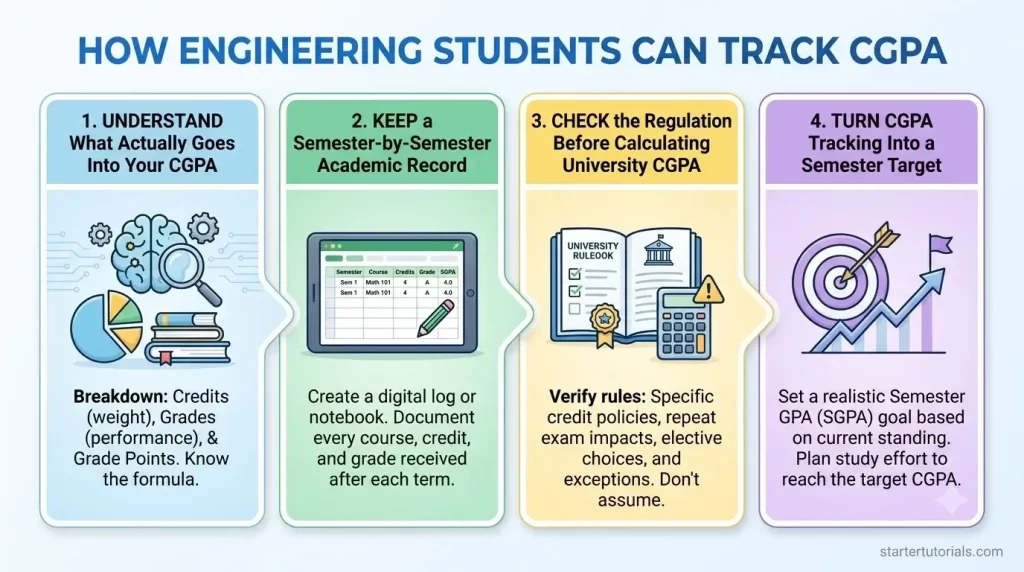
Understand What Actually Goes Into Your CGPA
CGPA is not simply a count of how many high grades you have received.
In a credit-based system, subjects can carry different credit values. A four-credit core paper normally contributes more to the weighted calculation than a one- or two-credit course. That makes the combination of credits and grade points important.
The basic idea can be expressed as:
GPA = Σ (Course Credit × Grade Point) ÷ Σ Course Credits
CGPA applies the same credit-weighted principle across the courses counted towards the cumulative result.
This distinction matters because students sometimes take the GPA from each semester, add the values together and divide by the number of semesters. That can produce a different result when the semesters do not carry the same number of applicable credits.
University regulations should always be treated as the final authority because grading systems, eligible courses and calculation rules can differ between institutions and even between academic regulations within the same university.
For example, Anna University’s Academic Regulations 2023 (Revision 1, 2024) for the relevant University Department B.E./B.Tech. programmes describe GPA as a credit-weighted average and calculate CGPA on the same general basis across applicable courses.
Keep a Semester-by-Semester Academic Record
You do not need complicated software to monitor your academic performance.
A simple spreadsheet or table containing the following information is usually enough:
- semester
- course name
- course credits
- grade or grade point
- semester GPA
- cumulative CGPA
Update it whenever a semester result is released.
Keeping the underlying course information is more useful than recording only your final GPA. If you later need to check a calculation, estimate the effect of a grade improvement or understand why your CGPA moved less than expected, the credits and grade points will be available.
This also helps when different semesters have different credit loads.
Suppose a student has completed three semesters:
Semester 1: GPA 8.20, 21 credits
Semester 2: GPA 8.55, 23 credits
Semester 3: GPA 8.10, 22 credits
Taking a simple average of the three GPAs gives about 8.28.
A credit-weighted calculation is slightly different:
(8.20 × 21) + (8.55 × 23) + (8.10 × 22)
= 172.20 + 196.65 + 178.20
= 547.05
Total credits:
21 + 23 + 22 = 66
So the weighted result is:
547.05 ÷ 66 = 8.29
The difference in this example is small, but the gap can become more noticeable when semester credit totals vary more widely.
Check the Regulation Before Calculating Anna University CGPA
Students should be particularly careful when using a CGPA calculator for a university that has more than one academic regulation in operation.
Anna University students, for example, may be studying under different regulations depending on their year of admission, programme, college type and whether the institution is autonomous or non-autonomous.
That means a grading table found online should not automatically be assumed to apply to every Anna University student.
The safest starting point is the regulation mentioned on your academic records or the official curriculum applicable to your batch.
Once that is known, an Anna University CGPA calculator can make the arithmetic easier by allowing students to calculate using semester GPA and credits or course-wise grades and credits. Course-wise calculation can be particularly useful when the goal is to reproduce the underlying credit-weighted method as closely as possible.
A calculator should still be treated as a convenience tool. Your official grade sheet and the academic regulation applicable to your programme remain the authoritative records.
Turn CGPA Tracking Into a Semester Target
Knowing your current CGPA is useful. Knowing what to do with that information is better.
Instead of beginning a new semester with a vague goal such as “I need to improve my CGPA,” translate that goal into something measurable.
Suppose your current cumulative performance is around 7.7 and you want to move towards 8.0. The first question should not be, “How can I get an 8 CGPA immediately?”
Ask:
How many credits have I already completed?
The more credits already included in your CGPA, the harder it becomes for one semester to make a large change to the cumulative figure.
A student who has completed only two semesters may see a noticeable change after one strong semester. A student approaching the final year has a much larger body of completed credits, so the CGPA normally moves more gradually.
This is why realistic semester targets are more useful than focusing only on the final number.
A student might decide that moving from a semester GPA of 7.4 to 8.2 is an achievable immediate target. Repeating that improvement over several semesters can have a more meaningful effect than expecting one exceptional result to compensate for years of earlier performance.
Identify High-Credit and High-Risk Subjects Early
Not every course has the same effect on your GPA.
Imagine two subjects:
Subject A: 4 credits
Subject B: 2 credits
Suppose you are currently heading towards a grade point of 7 in both subjects but believe better preparation could raise either result to 9.
For Subject A, the improvement in weighted grade points would be:
4 × (9 − 7) = 8
For Subject B:
2 × (9 − 7) = 4
Improving the four-credit course creates twice the weighted difference.
This does not mean students should ignore low-credit subjects. Every required course needs proper attention, and failing a course can create problems that go far beyond its effect on the CGPA.
The calculation simply helps identify where academic improvement can have a larger mathematical impact.
At the beginning of each semester, it can help to classify subjects in two ways.
A high-credit subject has a relatively strong influence on the semester GPA.
A high-risk subject is one where you are already struggling with concepts, internal assessments, attendance, laboratory work or prerequisite knowledge.
A course that falls into both categories deserves attention early.
Waiting until the study holidays to begin a difficult, high-credit core subject leaves very little room to recover.
Track More Than Examination Marks
CGPA improves as a result of better semester performance, and semester performance is built over several months.
That means your tracking system should not begin one week before the final examination.
Look at the academic signals already available during the semester: internal assessments, assignments, laboratory performance, project reviews, attendance and your understanding of completed units.
The purpose is not to predict your exact final grade. Without knowing the precise assessment structure and final examination performance, such predictions can easily become misleading.
Instead, look for patterns.
If your internal marks have been weak in the same subject twice, that subject needs attention.
If you repeatedly postpone one difficult unit, it will probably become harder when later topics depend on it.
If laboratory records and project work are taking much longer than planned, your study schedule may need to change before examination preparation begins.
A short review every one or two weeks can reveal these problems much earlier than a semester result.
Do Not Chase CGPA at the Expense of Engineering Skills
CGPA matters, but it is only one measure of academic performance.
A number on a grade sheet cannot fully show whether you can debug a program, design a circuit, interpret an engineering drawing, work with laboratory equipment, analyse data or explain a technical decision clearly.
Students sometimes respond to CGPA pressure by concentrating almost entirely on marks. That can become counterproductive, especially when preparing for internships and placements where practical knowledge and communication also matter.
A stronger semester plan gives space to both.
If a programming course carries important credits, improving your understanding of the subject can raise your academic performance while also building a skill that matters outside the examination hall. The same applies to design work, laboratory courses, core engineering concepts and technical projects.
The most useful question is therefore not simply:
“How can I increase my CGPA?”
It is:
“Which academic weaknesses are lowering my performance, and what can I improve this semester?”
That question leads to better decisions.
Make CGPA a Planning Number, Not a Result-Day Surprise
There is little value in checking CGPA repeatedly if nothing changes in the way you study.
Use it at specific points instead.
Review it after semester results are released. Understand how much each completed semester contributed. Before the next semester becomes busy, identify the subjects likely to require the most attention. During the semester, monitor actual performance rather than relying on assumptions.
If your university uses a credit-weighted system, pay attention to credits as well as grades. And when calculating CGPA, follow the regulation that actually applies to your batch rather than a formula copied from another university or an older academic regulation.
Done consistently, this turns CGPA from a number you discover at the end of a semester into a practical tool for planning the next one.

Leave a Reply