
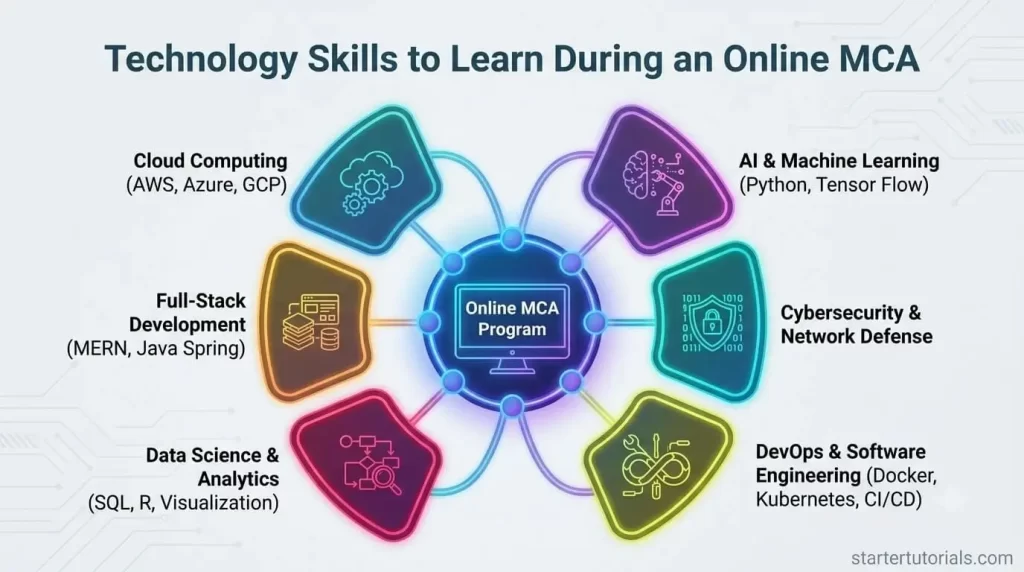
Technology roles are becoming broader. A software developer may need to work with databases, APIs, cloud services, and security controls in the same project. Someone entering data or AI roles needs more than Python syntax. Even professionals who do not work directly in cybersecurity are expected to understand secure coding and data protection.
An MCA gives learners time to build these capabilities in a structured sequence. The important part is deciding which skills deserve strong foundations and which areas need deeper study based on the role you want after graduation.
The following ten technology skills are worth developing during an online MCA. You do not need the same level of expertise in every area, but you should be able to show practical evidence of what you have learned.
Technology Skills MCA Students Should Build
| Skill | What you should be able to do |
| Java and OOP | Build structured object-oriented applications |
| Python | Create scripts, applications, and data workflows |
| Data structures and algorithms | Solve programming problems efficiently |
| Databases and SQL | Design, query, and connect databases |
| Full-stack development | Build complete web applications |
| AI and machine learning | Train and evaluate basic models |
| Generative AI and NLP | Build and assess language-based applications |
| Data analysis | Clean, analyze, and present data |
| Cybersecurity | Recognize and reduce common security risks |
| Cloud and software engineering | Version, test, and deploy applications |
1. Java and Object-Oriented Programming
Java remains useful for understanding how larger software applications are structured. Learning it should go beyond writing loops and simple console programs.
Focus on concepts such as:
- Classes and objects
- Inheritance
- Encapsulation
- Polymorphism
- Exception handling
- Collections
- File handling
- Modular programming
- Debugging
Object-oriented thinking helps learners break a large application into smaller components that can be developed, tested, and maintained separately.
A good practice project would be a Java-based inventory, student management, or booking application connected to a database.
2. Python Programming
Python is useful across software development, automation, data analysis, machine learning, and artificial intelligence. That makes it one of the more versatile languages an MCA student can learn.
Start with functions, data structures, modules, file handling, exceptions, and object-oriented concepts. From there, the direction can change depending on career goals.
A data-focused learner may move toward pandas and NumPy. Someone interested in AI can use Python for machine learning and NLP. A software learner might explore APIs, automation, or back-end development.
Instead of completing only programming exercises, try automating a repetitive task or building a small application that reads, processes, and stores data.
3. Data Structures and Algorithms
Programming languages change, but problem-solving fundamentals remain relevant.
Students should understand:
- Arrays
- Linked lists
- Stacks and queues
- Trees
- Hashing
- Searching
- Sorting
- Recursion
- Time complexity
- Space complexity
Knowing how to solve a problem is only one part of programming. You should also understand whether your solution remains efficient as the amount of data increases.
This skill is particularly useful during technical interviews, but its value is not limited to interviews. Algorithms influence application performance, search functions, data processing, and many other software tasks.
4. Database Design and SQL
Most applications eventually need to store, retrieve, or modify data. That makes database knowledge useful across software, analytics, AI, and enterprise technology roles.
Important areas include:
- Relational database concepts
- SQL queries
- Joins
- Primary and foreign keys
- Normalization
- Transactions
- Indexing
- Database design
- Query optimization
- Application-to-database connectivity
Do not stop after learning SELECT statements. Try designing a complete database for an application, deciding how tables relate to one another, and then connecting that database with Java, Python, or a web application.
5. Full-Stack and Web Application Development
Web development gives students an opportunity to bring several skills together in one project.
Useful foundations include:
- HTML and CSS
- JavaScript
- Client-server architecture
- Front-end and back-end interaction
- REST APIs
- Authentication
- Database integration
- Application testing
- Basic deployment
Frameworks will change over time, so understanding the underlying architecture is more useful than depending entirely on one framework.
A strong MCA project could be a complete web application with user authentication, database storage, an API layer, and a usable front end. That shows much more ability than several unrelated coding exercises.
6. Artificial Intelligence and Machine Learning
AI is becoming relevant across finance, healthcare, retail, software, marketing, and operations. MCA learners interested in these areas should understand how machine learning systems actually work rather than treating AI as a collection of tools.
Start with:
- Supervised and unsupervised learning
- Regression
- Classification
- Clustering
- Model training
- Validation
- Evaluation metrics
- Feature preparation
- Overfitting
- Introductory neural-network concepts
A useful project might involve predicting customer churn, detecting spam, classifying images, or forecasting demand.
The important part is being able to explain the data, model choice, evaluation method, and the result’s limitations.
7. Generative AI, NLP, and Large Language Models
Generative AI deserves separate attention from traditional machine learning because the development workflow is different.
Learners can begin with:
- Natural language processing
- Text preprocessing
- Embeddings
- Large language model concepts
- Prompt design
- LLM APIs
- Retrieval-augmented generation
- Output evaluation
- Hallucination and factual accuracy
- Responsible use of AI-generated code
Using an AI tool is easy. Evaluating whether its output is accurate, safe, and useful is the more valuable skill.
An MCA student could build a document question-answering application, text classifier, summarization tool, or conversational interface and then test how reliably it performs.
8. Data Analysis and Visualization
Not every data problem requires machine learning. Often, the first requirement is simply understanding what the data says.
Students should learn how to:
- Clean incomplete or inconsistent data
- Explore datasets
- Write SQL queries
- Analyze data with Python or R
- Use basic statistics
- Identify patterns and unusual values
- Create understandable visualizations
- Explain findings in plain language
This skill can be useful in data roles, but it also helps developers, project teams, and technical professionals make better decisions.
A practical project should begin with a raw dataset rather than a perfectly prepared one. Cleaning and interpreting the data is part of the work.
9. Cybersecurity Fundamentals
Security should not be treated as a skill only for cybersecurity specialists.
Developers, cloud professionals, database teams, and application administrators all make decisions that can affect system security.
Useful concepts include:
- Authentication and authorization
- Network-security fundamentals
- Secure coding
- Common application vulnerabilities
- Vulnerability assessment
- Risk assessment
- Data privacy
- Digital forensics
- Basic security governance
Students who want to move deeper into cybersecurity can later study penetration testing, forensic investigation, blockchain security, or security compliance.
A useful learning exercise is to inspect a controlled test application, identify vulnerabilities, and document how to correct them.
10. Cloud, Version Control, and Software Engineering
Writing code is only one stage of software development. Students should also understand what happens when an application moves from a laptop into a working environment.
Focus on:
- Git and version control
- Software development lifecycle
- Linux basics
- Cloud-computing concepts
- Virtualization
- Testing
- Deployment
- API hosting
- Basic CI/CD concepts
- Monitoring
- Software project management
AWS, Azure, Docker, or similar platforms can be useful tools, but the underlying concepts matter more than learning one platform mechanically.
A simple goal is to put an application under version control, document the project clearly, and deploy it to a cloud environment.
How Online MCA Curricula Can Bring These Skills Together
Students do not have to learn every technology through separate short courses. A well-structured MCA can introduce computing foundations first, then offer opportunities to build deeper capability through electives, specializations, labs, and projects.
The table below highlights how selected programs structure their MCA courses to integrate these essential skills:
- Curriculum Flexibility: Both institutions offer structured paths, either elective tracks or specialized concentrations, allowing students to align their learning with career goals.
- Technology Coverage: The curriculum spans foundational areas like Java, Python, and algorithms, as well as emerging fields such as AI/ML, Generative AI, and Cybersecurity.
- Practical Component: Hands-on labs, programming practice, and virtual environments support learning and ensure industry readiness.
- Project Milestones: Courses culminate in real-world application through mini-projects, capstones, and substantial multi-credit final projects.
| Program | Curriculum approach | Technology areas covered | Practical learning |
| Online MCA Degree from SRMIST | Three elective tracks | Java, Python, databases, algorithms, full stack, cloud, AI, Generative AI, cybersecurity | Programming labs, virtual lab, mini project, capstone |
| Online MCA Course from SRM University Sikkim | Core curriculum plus three specializations | Java, Python, algorithms, web development, AI/ML, IoT, Gen AI, data science, cybersecurity | Practical labs, mini project, 12-credit final project |
Online MCA Degree from SRMIST
SRMIST structures its two-year Online MCA Degree around three elective tracks: General Computer Applications, Generative AI, and Cyber Security and Forensics.
The common and elective curriculum covers Java, Python, databases, operating systems, algorithms, Android development, full-stack development, cloud computing, AI, NLP, large language models, cyber forensics, and security-related subjects. Practical components include programming labs, a mini project, and a capstone project. This structure lets learners build computing fundamentals before focusing on a technical direction that matches their interests.
Online MCA Course from SRM University Sikkim
SRM University Sikkim structures its two-year online MCA course around an 80-credit curriculum that combines core computing subjects with three specializations: AI and Gen AI, Data Science and Machine Learning, and Cyber Security and Cyber Forensics.
Learners study areas such as Java, Python, advanced data structures and algorithms, web application development, AI and machine learning, IT infrastructure, and IoT. Depending on the specialization, later subjects can include large language models, GenAI application development, big data analytics, visualization, penetration testing, and digital forensics. The curriculum also includes practical coursework, a mini project, and a 12-credit final project.
Turn Your MCA Skills Into a Technical Portfolio
Learning becomes more valuable when there is something concrete to show for it.
By the end of the program, try to build a portfolio containing:
- One Java or Python application
- One database-backed web project
- One data-analysis project
- One AI or machine learning project
- One Generative AI or NLP application
- One security, cloud, or infrastructure-focused project
- Well-documented GitHub repositories
- A final project aligned with your preferred career direction
Quality matters more than the number of repositories. A smaller project that is complete, documented, tested, and clearly explained can demonstrate more ability than several unfinished applications.
Final Thoughts
An MCA student does not need equal depth across all ten skills.
Someone targeting software development may spend more time on Java, algorithms, databases, full-stack development, and cloud concepts. A learner interested in AI may go further into Python, data analysis, machine learning, NLP, and large language models. Cybersecurity-focused students may prioritize networks, operating systems, secure coding, vulnerability assessment, and digital forensics.
The better approach is to build strong computing fundamentals first, then develop deeper capability in the technologies connected with the job you want. Use labs, assignments, mini projects, and the final project to turn those skills into evidence that you can actually build and solve technical problems.

Leave a Reply