
Join our newsletter! - Tips, contests and more. Click here to subscribe!
In this article we will learn about component diagrams in UML. This article is a part of our UML tutorial for beginners.
Introduction
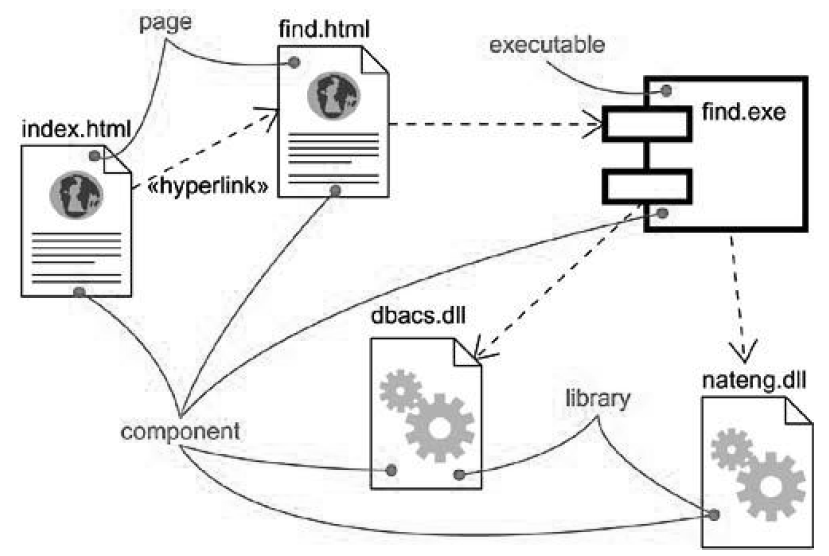
Component diagrams are one of the two kinds of diagrams for modeling the physical aspects of object-oriented software systems. A component diagram shows the organization and dependencies among a set of components. We use component diagrams to model the static implementation view of a software system.
Common Properties
A component is just a special kind of a diagram and shares the same common properties as the other diagrams like: a name and graphical contents. What distinguishes a component diagram from the rest of the diagrams is its content.
Content of Component Diagram
Component diagram commonly contain:
- Components
- Interfaces
- Dependency, generalization, association and realization relationships.
Like all other diagrams, component diagrams may contain notes and constraints. Component diagrams may also contain packages.
Common Uses
When modeling the static implementation view of a system, we will typically use component diagrams in one of four ways:
- To model source code.
- To model executable releases.
- To model physical databases.
- To model adaptable systems.
Common Modeling Techniques
Modeling source code
To model a system’s source code:
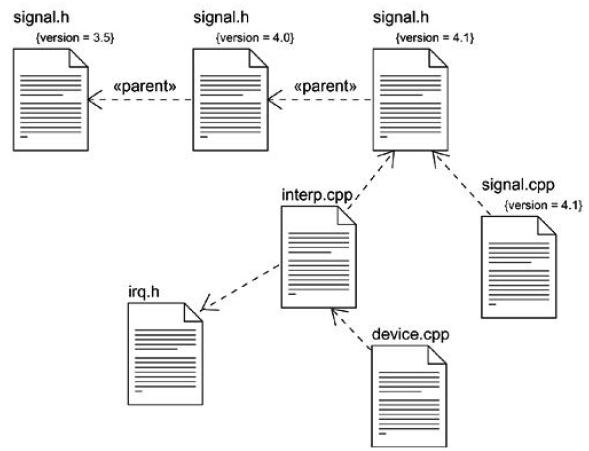
- Either by forward or reverse engineering, identify the set of source code files of interest and model them as components stereotypes as files.
- For larger systems, use packages to show groups of source code files.
- Consider using tagged values indicating such information as the version number of the source code file, its author, and the date it was last changed.
- Model the compilation dependencies among these files using dependencies.
Modeling an executable release
To model an executable release:
- Identify the set of components you’d like to model.
- Consider the stereotype of each component in this set.
- For each component in this set, consider its relationship to its neighbors. Most, often this will involve interfaces that are realized by certain components and then imported by others.
Modeling a physical database
To model a physical database:
- Identify the classes in your model that represent your logical database schema.
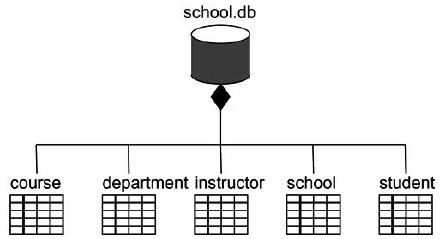
- Select a strategy for mapping these classes to tables. You have to also consider the physical distribution of your databases.
- To visualize, specify, construct and document your mapping, create a component diagram that contains components stereotyped as tables.
- Where possible, use tools to help you transform your logical design into a physical design.
Modeling adaptable systems
To model an adaptable system:
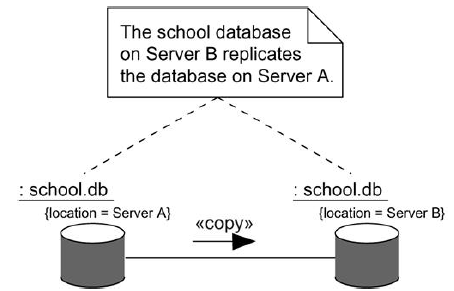
- Consider the physical distribution of the components that may migrate from node to node. We can specify the location of a component instance by marking it with a location tagged value.
- If you want to model the actions that cause a component to migrate, create a corresponding interaction diagram that contains component instances. We can illustrate a change of location by drawing the same instance more than once, but with different values for its location tagged value.
Next let’s learn about deployment in UML.

Mr. P.S.Suryateja, also known as Suryateja Pericherla, is at present a Research Scholar (full-time Ph.D.) in the Dept. of Computer Science & Systems Engineering at Andhra University, Visakhapatnam. Previously worked as an Associate Professor in the Dept. of CSE at Vishnu Institute of Technology, India.
He has 14+ years of teaching experience and is an individual researcher whose research interests are Cloud Computing, Internet of Things, Computer Security, Network Security and Blockchain.
He is a member of professional societies like IEEE, ACM, CSI and ISCA. He published several research papers which are indexed by SCIE, WoS, Scopus, Springer and others.
Leave a Reply