
This article provides a comprehensive introduction to C programming language which is the base for many other programming languages. This article is a part of C programming tutorial for beginners.
Overview of C
C is a high-level, procedural programming language known for its efficiency, portability, and flexibility. It provides programmers with low-level access to memory and system resources, making it ideal for system software, game development, and embedded systems.
Its syntax, influenced by earlier languages like B, has become a standard for learning programming concepts and developing complex applications.
C programming is a powerful and widely-used programming language that serves as the foundation for many modern software applications. Developed in the early 1970s by Dennis Ritchie at Bell Labs, C has played a crucial role in the evolution of programming languages and software development.
Watch this video for an introduction to C programming language:
Features and Characteristics of C Programming
- Procedural Language: C follows a procedural programming paradigm, focusing on functions and sequence of steps to perform tasks.
- Efficient and Fast: C code compiles into machine language, enabling high-speed execution, making it ideal for system-level programming.
- Low-Level Access: C provides direct access to memory through pointers, allowing manipulation of hardware and system resources.
- Portability: Programs written in C can be easily transferred and executed across different computer systems with minimal changes, thanks to its standardized syntax and libraries.
- Rich Library Support: C offers a comprehensive set of built-in functions and libraries that facilitate various programming tasks.
- Modularity: Code can be divided into functions, enhancing readability, maintainability, and reusability.
- Structured Language: C encourages structured programming, which helps in writing clean and manageable code.
- Memory Management: Manual management of memory through functions like malloc() and free() gives programmers control over system resources.
- Extensibility: C can be extended with additional libraries and is compatible with various hardware and software environments.
Understanding these features and characteristics makes C an excellent starting point for mastering programming fundamentals and developing efficient, high-performance applications.
Applications of C Programming Language
The applications which can be developed using C language are literally unlimited. Some of the types of applications which can be developed using C language are:
- Operating Systems: Many operating systems, including Unix and Linux, are written primarily in C.
- Embedded Systems: Device drivers, IoT devices, and microcontroller programming often utilize C due to its low-level capabilities.
- Compilers and Interpreters: Building language parsers and interpreters relies on C for performance and control.
- Game Development: Many game engines and graphics applications are developed using C for performance reasons.
- Software for Hardware Devices: Device firmware, sensors, and other hardware interfaces are programmed in C.
In summary, C programming remains a fundamental language that provides the tools and features necessary for developing efficient, portable, and impactful software across various domains.
History of C Programming Language
The origins of C trace back to the early 1970s at Bell Labs, where Dennis Ritchie developed the language to improve the UNIX operating system. It was designed as an evolution of the B language, with added features to support structured programming and data abstraction.
Since its creation, C has become one of the most influential programming languages, forming the foundation for many modern languages like C++, C#, and Objective-C. Its simplicity, combined with powerful features, has made it a preferred choice for programmers worldwide.
Key Milestones in the Development of C
- Early development at Bell Labs (1972)
- Introduction of the C language standard (ANSI C, 1989)
- Further standardization with C99 and C11 updates
- Widespread adoption in academia, industry, and open-source projects
Today, C remains relevant due to its efficiency, portability, and extensive ecosystem, making it an essential language for both beginners and experienced developers.
Importance of Learning C
C is known for its efficiency, portability, and close-to-hardware capabilities. It serves as a fundamental building block for understanding computer science concepts and programming fundamentals.
- Foundation for Other Languages: Many languages such as C++, Java, and Python have origins rooted in C. Learning C provides a strong base for mastering these languages.
- Understanding Computer Architecture: C allows programmers to operate at a low level, offering insights into how memory management, pointers, and hardware interaction work.
- Efficiency and Performance: C programs are highly efficient, making it suitable for system programming, embedded systems, and applications requiring optimized performance.
- Widely Used in Industry: C is extensively used in system/software development, operating systems (like UNIX), and embedded system development, making skills in C highly valuable for careers in these areas.
- Learning Curve: The syntax and concepts of C can be a bit challenging initially, but mastering it enhances problem-solving skills and understanding of programming logic.
Core Syntax and Elements in C
Understanding the core syntax and elements of c is essential for writing correct and effective programs. Below are some of the fundamental components:
Headers and Preprocessor Directives
Used to include libraries and define constants or macros.
Example:
#include <stdio.h>
#define PI 3.14
Main Function
Main function is the entry point of every C program.
int main()
{
	// code
	return 0;
}
Variables and Data Types
Variables store data, and data types define the kind of data.
Examples:
int age = 25;
float price = 99.99;
char grade = 'A';
Operators
Used for performing operations like arithmetic, comparison, and logical operations.
Example:
int sum = a + b;
if(a > b)
{ ... }
Control Structures
Control the flow of the program.
Examples:
if(condition)
{
	//code
}

while(condition)
{
	//code
}

for(int i = 0; i < 10; i++)
{
	//code
}
Functions
Reusable blocks of code to perform specific tasks.
Example:
void printMessage()
{
	printf("Hello, World!\n");
}
Syntax Rules
Important rules include ending statements with semicolons, using curly braces for blocks, and proper variable declarations. Comments are added using // for single-line or /* */ for multi-line comments.
Mastering these core syntax elements will help you write effective C programs and lay a strong foundation for further learning in programming.
Writing and Running a Simple C Program
Getting started with C involves writing a program using a text editor, compiling it with a C compiler, and executing the resulting program.
Here is a basic example of a C program that prints a message to the console:
#include <stdio.h>
int main()
{
	printf("Hello, World!\n");
	return 0;
}
Steps to run this program:
- Save the code in a file named hello.c.
- Open a terminal or command prompt and navigate to the directory containing hello.c.
- Compile the program using a C compiler like GCC: gcc hello.c -o hello
- Run the compiled program: ./hello
You will see the message (output):
Hello, World!
Congratulations! You’ve written and run your first C program. As you progress, you’ll explore more complex programs involving conditions, loops, functions, and data structures.
Differences Between C and C++
Following are differences between C and C++:
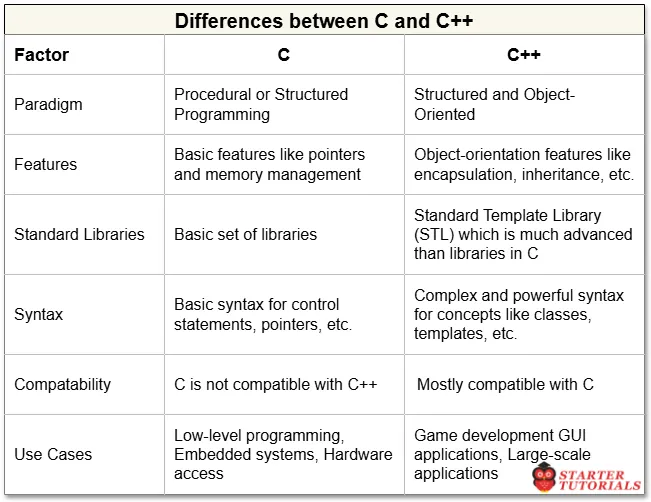
- Paradigm: C is procedural, focusing on function-based programming. C++ extends C with object-oriented features like classes and objects, supporting multiple paradigms.
- Features: C++ introduces features such as inheritance, polymorphism, and encapsulation, which are not available in C.
- Standard Libraries: C has a simpler standard library, primarily focusing on input/output, string handling, and mathematical functions. C++ offers a richer Standard Template Library (STL), including data structures, algorithms, and iterators.
- Syntax: C++ introduces additional syntax for classes, templates, and exception handling, making it more complex but powerful.
- Compatibility: C++ is largely compatible with C; most C code can be compiled with a C++ compiler. However, C++ adds features that are not present in C, providing more abstraction and reusability.
- Use Cases: C is preferred for low-level programming, embedded systems, and scenarios where hardware access is critical. C++ is used for software requiring higher-level abstractions, like game development, GUI applications, and large-scale systems.
The differences between C and C++ in table format:
| Factor | C | C++ |
|---|---|---|
| Paradigm | Procedural or Structured Programming | Structured and Object-Oriented |
| Features | Basic features like pointers and memory management | Object-orientation features like encapsulation, inheritance, etc. |
| Standard Libraries | Basic set of libraries | Standard Template Library (STL) which is much advanced than libraries in C |
| Syntax | Basic syntax for control statements, pointers, etc. | Complex and powerful syntax for concepts like classes, templates, etc. |
| Compatability | C is not compatible with C++ | Mostly compatible with C |
| Use Cases | Low-level programming, Embedded systems, Hardware access | Game development GUI applications, Large-scale applications |
Following image shows the differences between C and C++:
Conclusion
Understanding the basics of C programming lays a strong foundation for advanced programming languages and computer science concepts. Its enduring popularity is a testament to its significance in the history and development of modern computing. Whether you’re interested in system development, embedded programming, or just want to learn programming fundamentals, C remains an essential language to master.
Frequently Asked Questions
After reading the introduction to C programming language, now you are ready to learn the process of creating and running C programs in detail.

Mr. P.S.Suryateja, also known as Suryateja Pericherla, is at present a Research Scholar (full-time Ph.D.) in the Dept. of Computer Science & Systems Engineering at Andhra University, Visakhapatnam. Previously worked as an Associate Professor in the Dept. of CSE at Vishnu Institute of Technology, India.
He has 14+ years of teaching experience and is an individual researcher whose research interests are Cloud Computing, Internet of Things, Computer Security, Network Security and Blockchain.
He is a member of professional societies like IEEE, ACM, CSI and ISCA. He published several research papers which are indexed by SCIE, WoS, Scopus, Springer and others.
I really appreciate how the article combines both syntax explanations and real-world applications; it makes starting with C feel much less intimidating. Highlighting core concepts like control structures and functions early on is especially helpful for beginners trying to build a strong foundation.